The Decision That Outweighs the Budget
Los Angeles is the most expensive place in America to market a law firm badly. Personal injury clicks run $150 to $400. More than 14,000 firms compete across LA County. At those prices, the difference between a good agency and a mediocre one isn't a rounding error on your budget — it is the budget.
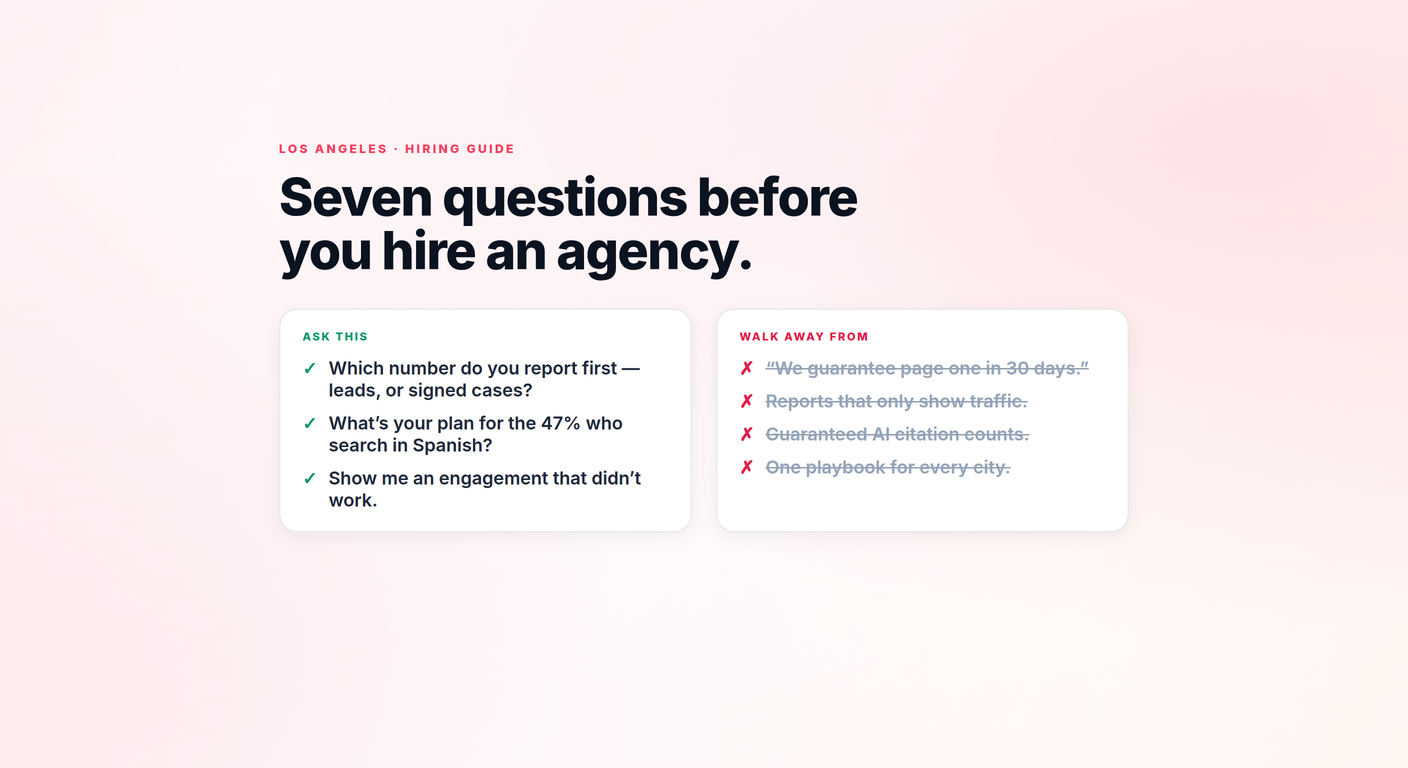
Yet most firms choose an agency the same way clients are told never to choose a lawyer: from a cold email, a slick deck, and a promise that sounds too specific to be honest. This guide is the interview we would want a firm to run on us — seven questions, what a real answer sounds like, and the red flags that should end the meeting.
Question 1: "Which number will you report first — leads, or signed cases?"
This one question filters out most of the industry. Almost every agency reports conversions: form fills and calls. Conversions are easy to buy and easy to inflate. Signed cases are neither.
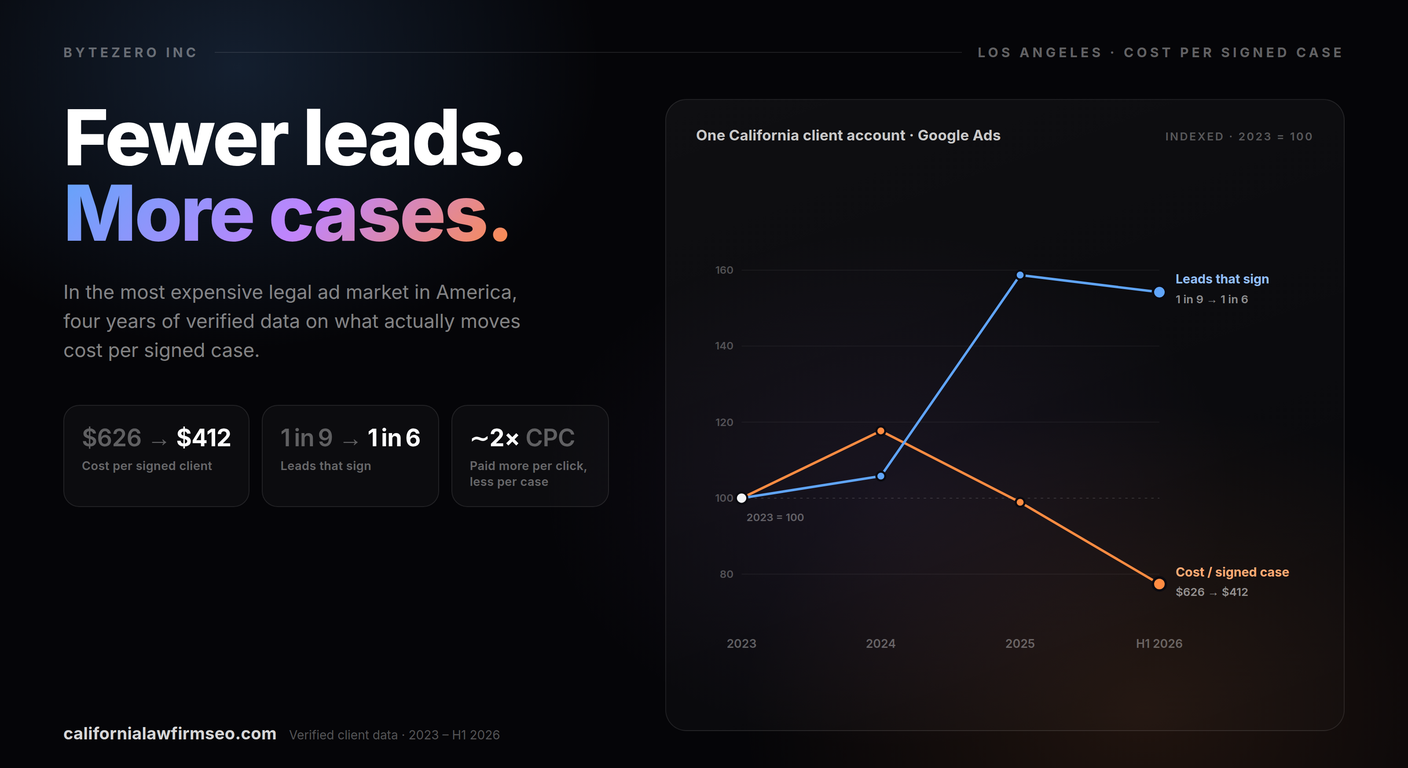
The two numbers can move in opposite directions. In one California account we run, lead volume fell roughly 40% while signed clients per lead rose by a third and cost per signed client dropped from $626 to $412 — because budget deliberately moved off cheap, broad traffic. An agency reporting only conversions would have looked like it was failing while the firm's economics improved. We published the full four-year dataset in The Los Angeles Lead Trap.
A real answer: "We'll set up signed-case tracking by source in month one, and every report leads with cost per signed case." A pretender's answer: anything that starts with traffic.
Question 2: "What does ranking in Los Angeles actually mean?"
LA County is roughly 76 distinct neighbourhood markets stacked on top of each other. A searcher in Long Beach does not call a firm that only signals downtown. The head terms — "Los Angeles personal injury lawyer" — are the most contested phrases in American legal search, and no honest agency promises them quickly.
A real answer names neighbourhoods: which submarkets your cases actually come from, which ones you can win in 3–6 months, and how those pages compound into the county terms over 6–12. We broke down the full mechanics in what it actually takes to rank in LA. A pretender's answer promises page one in 30 days — which in this market means either branded terms nobody competes for, or a lie.
Question 3: "How do you handle the 47% of this county that speaks Spanish at home?"
Nearly half of Los Angeles County speaks Spanish at home, and the majority of firms still market in English only. If an agency's answer is a translation plugin, they are about to spend your money making your firm look careless to the largest underserved audience in the market.
A real answer covers a separate Spanish content track (not mirrored pages), native-quality copy reviewed by a bilingual attorney, hreflang-correct architecture, and — critically — whether your intake can actually serve Spanish-speaking callers before anyone drives that demand.
Question 4: "What happens when a client asks ChatGPT instead of Google?"
A growing share of LA legal decisions now start with an AI answer that names two or three firms — and there is no position four. Ask the agency how a firm earns those citations. A real answer involves entity establishment, schema, extractable content and weekly citation monitoring — the discipline of generative engine optimization. It also includes an honest caveat: nobody can guarantee a number of AI citations, because nobody controls the models. A pretender's answer is a guaranteed citation count, which is a promise about someone else's product.
Question 5: "Who reviews the content for State Bar compliance?"
Everything a California firm publishes lives under California Rules of Professional Conduct 7.1–7.5 — advertising, testimonials, specialisation claims, case-result framing. A national agency running the same playbook in Phoenix and Dallas usually doesn't know these rules exist. A real answer treats compliance as an architectural constraint on how content gets written, with attorney review before publication — not a disclaimer pasted on afterwards.
Question 6: "What's your mobile speed standard, and why?"
78% of LA legal search happens on a phone, and crisis searches — DUI above all — cluster between 11 PM and 3 AM. A site that takes six seconds to become usable loses the case before anyone reads a word. A real answer is a number: Largest Contentful Paint under 2.5 seconds on mobile, tested on cellular, with the phone number tappable immediately. If the agency has never measured their own clients' sites, they won't measure yours.
Question 7: "Show me sourced numbers — including one engagement that didn't work."
Every agency has a highlight reel. Ask for the sourcing instead: which analytics system, what date range, published with whose permission. Then ask for the engagement that underperformed and what changed. An agency that can't name one is either brand new or editing history. We publish our own this way — real client dashboards, stated windows, and the parts that aren't finished yet — in our case studies.
The Red Flags That End the Meeting
- "We guarantee page one." In LA, nobody honest does.
- Reports that lead with traffic and never mention signed cases.
- One national playbook — no neighbourhood strategy, no Spanish plan, no CRPC awareness.
- Guaranteed AI citation counts. A promise about a system they don't control.
- Review incentives. Against Google policy and a State Bar exposure — an agency suggesting it is volunteering your licence for their KPI.
- They rank for nothing themselves. An SEO agency you can't find in search is telling you the punchline early.
What a Real LA Engagement Looks Like
For calibration, the shape we believe an honest Los Angeles engagement takes: an audit of your current visibility across LA submarkets first; a neighbourhood-and-practice-area strategy mapped to where your cases actually come from; the build — site speed, schema, bilingual architecture, content; then measurement against signed cases, monthly, with the numbers you can check yourself. That is the model behind our Los Angeles law firm marketing engagements, and it's the standard we'd hold any competitor to as well.
Choosing an LA Marketing Agency — Common Questions
How much should an LA firm budget?
Less than you think if it's measured, more than you'd like if it isn't. The honest answer is scoped to practice area and submarket — a Camarillo estate planner and a downtown PI firm are different businesses. What matters is that every dollar reports back as cost per signed case.
Should we hire a legal-specialist agency or a strong generalist?
In California, specialist — not for the marketing skill, but for the constraints. CRPC 7.1–7.5, bilingual intake, and the LA submarket map are the parts generalists learn at your expense.
How fast should we expect results?
Paid campaigns produce leads in weeks. Organic neighbourhood terms move in 3–6 months; county head terms in 6–12. Anyone materially faster is describing something other than what you think you're buying.
The fastest way to test any agency — including us — is to make them show you where you stand first. Get a free AI visibility audit: your rankings, your AI citations, and the gaps, mapped across LA County before you spend anything.