Los Angeles Is Where This Mistake Costs the Most
A personal injury click in Los Angeles can run $150 to $400 on Google Ads. Not a case — a click. That single fact makes LA the market where measuring the wrong number is most expensive, and where almost every firm is measuring the wrong number.
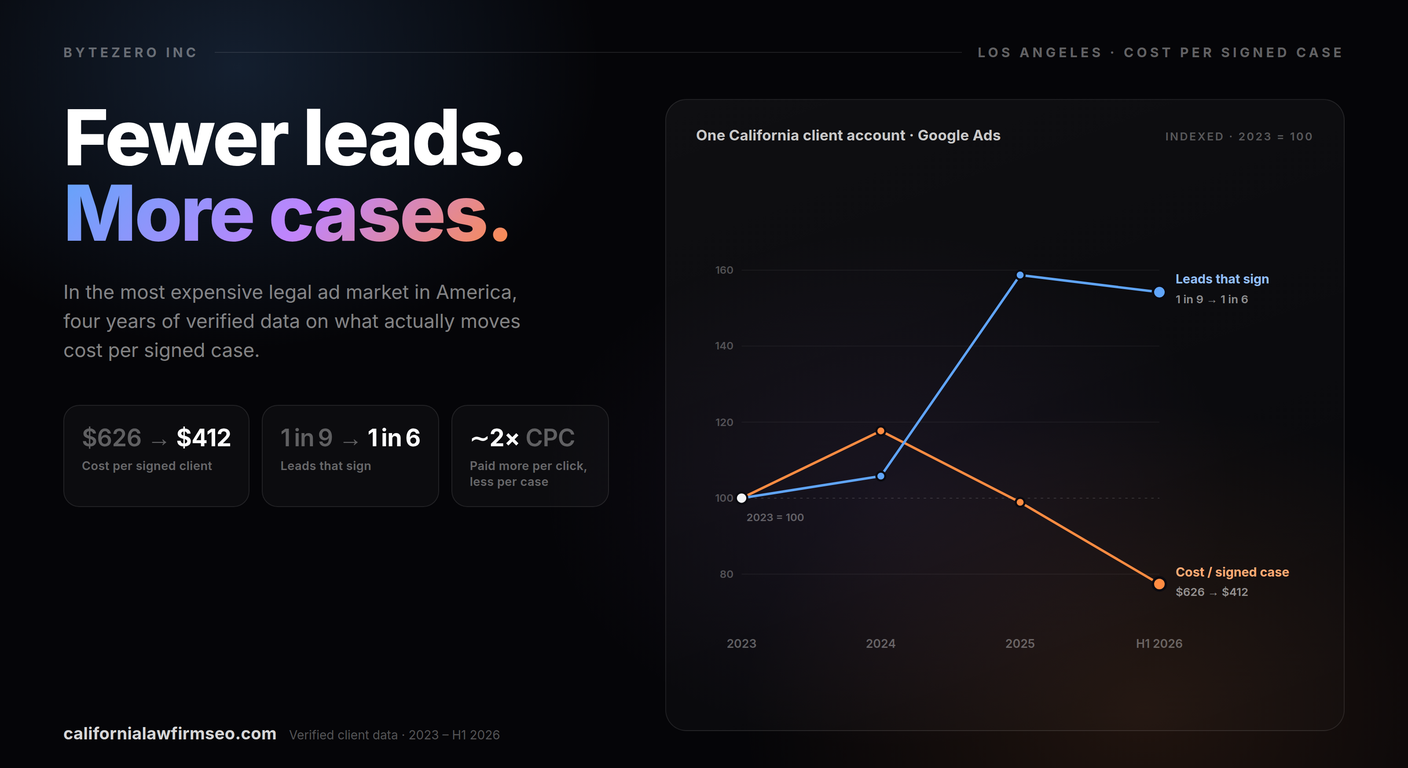
Here is what that looks like in real campaign data. In 2024, a California employer-defense practice we run paid search for produced 1,094 conversions — form fills, calls, the things every agency dashboard in America puts on the front page. Those 1,094 conversions became 124 signed clients. Roughly one client for every nine conversions.
In the first half of 2026, the same account produced 684 conversions. Fewer leads. Substantially fewer. It also produced 113 signed clients — one for every six.
Read those two lines together and the entire premise of conversion-count reporting falls apart. Lead volume fell nearly 40% while the firm signed more paying clients per lead by a third. Cost per signed client fell from $626 to $412. And that happened while average cost per click roughly doubled, from about $6 to about $12, because we deliberately walked away from cheap, broad traffic.
Paying twice as much per click and still cutting cost per signed case by a third is the part that cannot be faked with a screenshot of a traffic graph. The full sourced record is in our case studies.
Now apply that arithmetic to LA click prices. A firm buying $400 personal injury clicks at one-signed-client-per-nine-conversions is running a fundamentally different business from the firm next door getting one per six — and both of their monthly reports can show the conversion line going up. If you want the ranking mechanics for this market, we cover those separately in what it actually takes to rank in Los Angeles. This article is about the number underneath them.
Part I: The Industry Optimizes the Wrong Variable
Ask most law firm marketing agencies for a monthly report and you will receive traffic, keyword positions, and conversions. All three are real. None of them is revenue.
The distance between a conversion and a signed case is where a legal practice actually lives, and it is enormous. A personal injury click in Los Angeles can run $18 to $42 on the low-competition end and far higher for the money terms. At a 5–8% landing page conversion rate and a consult-to-retainer rate near 25%, a signed PI case bought purely through paid search routinely costs $3,000 to $8,000 in media alone, before anyone's management fee. We break the channel economics down further in Google Ads vs SEO for California law firms.
You cannot optimize your way out of that with better ad copy. You optimize your way out of it by changing which number you're steering toward. Here is what four years of continuous tracking looks like when the client's own definition of a win — a signed Letter of Engagement — is the measured variable rather than a proxy for it:
- 2023 — $70,167 spent · 1,232 conversions · 132 signed clients · $532 per signed client
- 2024 — $77,578 spent · 1,094 conversions · 124 signed clients · $626 per signed client
- 2025 — $85,194 spent · 953 conversions · 162 signed clients · $526 per signed client
- 2026 (first half) — $46,610 spent · 684 conversions · 113 signed clients · $412 per signed client
Note 2024 to 2025 in particular: annual spend moved roughly 10%, and signed clients rose 31%. The gain didn't come from budget. It came from refusing traffic that converted well and signed poorly.
The lesson generalizes past paid search, which is why it belongs at the top of an article about SEO. Every channel a law firm runs can be tuned toward volume or toward case value. Most firms have never told their agency which one they want, and silence defaults to volume, because volume is what makes a report look good.
The single most valuable thing most California firms could do this quarter costs nothing: start reporting signed cases by source, monthly, next to the conversion count. The first month that the two lines disagree is the month you learn what your marketing is actually doing.
Part II: Four Reasons Los Angeles Punishes This Mistake Hardest
Every market rewards measuring signed cases. LA is where failing to do it compounds fastest, for four structural reasons.
1. The click prices leave no margin for waste
In a market where a personal injury click costs $150 to $400, the difference between one signed client per nine conversions and one per six is not a rounding error — it is the difference between a profitable practice and an expensive hobby. Cheaper markets forgive sloppy targeting because the wasted clicks are cheap. LA does not forgive anything.
2. Ten million people means dozens of markets, each with its own conversion rate
Los Angeles County holds roughly 9.7 million people across dozens of distinct legal micro-markets. A Sherman Oaks searcher and an Inglewood searcher have different case profiles, different values, and different likelihoods of signing. Reporting a single county-wide conversion number averages all of that into meaninglessness — and averages are where expensive problems hide.
3. Mobile-first search behavior breaks the intake, not just the site
Mobile traffic share runs around 78% in Los Angeles County in the data we track. DUI searches cluster between 11 PM and 3 AM, on phones, from people in crisis. A conversion recorded at 2 AM that nobody calls back until Tuesday is a conversion that will never become a case — and it still shows up as a win on the report. Our speed guide covers what the site side of this costs.
4. Nearly half the county's demand is in a language most firms don't serve
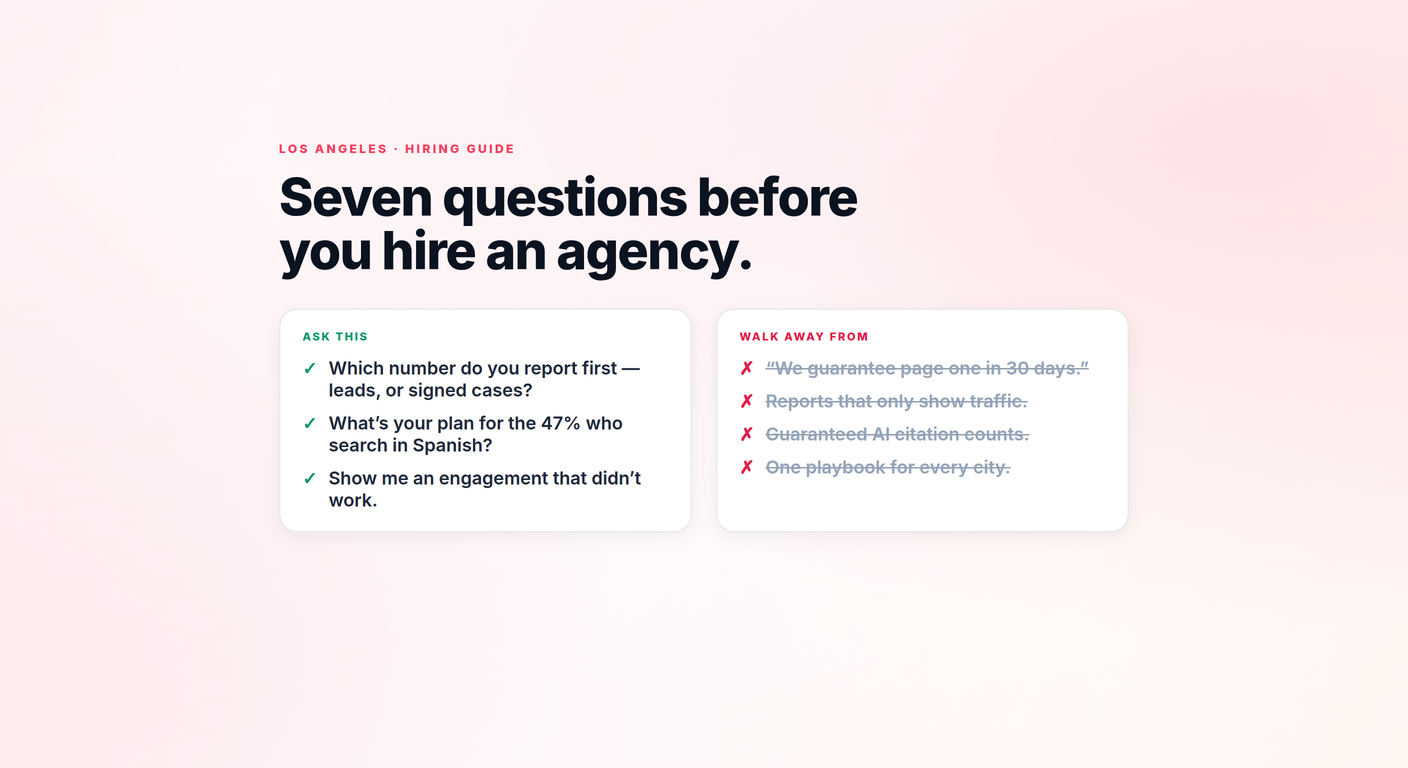
Los Angeles County is roughly 47% Spanish-speaking. Machine-translated pages actively damage trust with exactly the audience they're meant to win. Native-quality Spanish content remains one of the few places in LA legal search where real demand still meets thin competition — and it tends to convert to signed cases at a materially better rate than the English head terms it sits beside.
And California has its own advertising rules
Every page a California firm publishes lives under California Rules of Professional Conduct 7.1–7.5 — communications about services, advertising, solicitation, firm names, specialization claims. Testimonial disclosures, "specialist" language, and case-result framing all have hard constraints a generic content vendor will not know exist. Add WCAG 2.1 AA accessibility, which is both an ADA exposure question and a crawlability one. Compliance is not a legal-review step bolted on at the end. It's an architectural constraint on how the content can be written at all.
Part III: The Interface Changed. Most Firms Haven't Noticed Yet.
For twenty-five years, the goal of law firm SEO was a position on a page of ten blue links. That page is being replaced — not gradually — by a single synthesized answer that names two or three firms.
When an Angeleno now asks ChatGPT, Perplexity, Google's AI Overviews, Claude, Gemini, or Copilot for "the best employment lawyer in Los Angeles," they do not receive a ranked list to evaluate. They receive a recommendation. There is no position 4 in an AI answer. You are cited or you are invisible, and the searcher never learns you existed.
This is the discipline now called GEO (generative engine optimization) or AEO (answer engine optimization), and it is not a rebranding of SEO. The ranking inputs are genuinely different:
- Entity establishment. AI engines reason over entities, not pages. Your firm has to exist as a recognized, disambiguated thing — in Google's Knowledge Graph, in Wikidata, in consistent citations across directories — before a model can confidently name it. Most law firms have never been established as an entity at all; they have a website, which is not the same claim.
- Citation architecture. Content has to be written for extraction. Clear, self-contained answers. Verified figures. Explicit attribution to a named attorney with credentials. A 2,000-word narrative page that never states a direct answer in a quotable sentence is nearly uncitable, no matter how well it ranks.
- Structured data as the machine-readable layer. LegalService, Attorney, FAQPage, HowTo, LocalBusiness, Breadcrumb. Schema is how you tell a model what you are and where you practice, without hoping it infers correctly from prose.
- Platform-specific behavior. These engines do not share ranking signals. Training-data recency, citation density, authoritative outbound linking, and entity mention frequency carry different weights across ChatGPT, Perplexity, and Google's AI surfaces.
- E-E-A-T, load-bearing in a way it never was for rankings alone. Legal content is classified "Your Money or Your Life." Author markup, bar admission numbers, real attorney bios, links to State Bar profiles, citations to the California Courts and the actual statute are the trust signals an AI engine uses to decide whether repeating your claim is safe.
- Measurement, weekly. Query the AI platforms on your target terms on a schedule and record when and how your firm appears. Gaps become the content roadmap. Appearances become a moat, because every citation reinforces the entity authority that makes the next citation easier.
Two things worth saying plainly, because most vendors won't. First: AI answers cite organic content, not ads. No amount of paid budget buys a position in a generated answer. A firm invisible in organic search is structurally invisible in AI search too. Second: this discipline is young. Anyone selling you a guaranteed number of AI citations is selling you something they cannot control. What's defensible is the method — and the fact that firms doing it now compete against a field that mostly hasn't started.
Part IV: The Five Failure Modes We Find in Los Angeles Firms
The five-page brochure. A criminal defense practice handles dozens of charge types. A five-page site can rank for approximately none of them and gives an AI engine nothing specific enough to cite. One Los Angeles criminal defense client came to us with exactly that. The rebuild went to 32 pages at launch, 100% carrying JSON-LD schema — built on three reusable templates so a fifth practice area becomes a data entry instead of a new build.
Buying leads instead of building an asset. Lead-gen services sell the same LA personal injury enquiry to four firms and call it a lead. One California firm we worked with was paying $340 per recycled lead before replacing the model with owned content. Rented visibility ends the moment the invoice stops. Ranked pages don't.
Half-hearted Spanish. In a county that is 47% Spanish-speaking, translated pages perform worse than no Spanish pages, because they signal to the exact audience you're courting that you didn't take them seriously. Go native or don't go.
Ignoring speed as a conversion variable. With 78% of LA legal search on mobile and a meaningful share of it happening at 2 AM, load time is not a technical metric. It's the intake process.
No review system. Google reads what reviews say, not just how many stars they carry. Thirty reviews mentioning "car accident" and "settlement" teach Google that your firm belongs in personal injury results for queries your website never targeted. Review count, average, velocity, and recency are confirmed local ranking factors, and sentiment is now a direct input to AI recommendations. The full system is in our Google reviews playbook.
Part V: The Honest Ledger
Here is a result from our own portfolio that most agencies would never publish.
A California employer-defense conversion property we built took 9,260 sessions and 476 conversions over the twelve months to August 2026 — a 5.1% site-wide conversion rate. Inside that total, paid search delivered 4,936 sessions and 358 conversions: a 7.3% conversion rate, roughly double what a well-run legal PPC landing page typically returns.
Now the part that belongs in the same paragraph: organic search delivered 178 sessions in those twelve months. Search Console shows the property earning 3,102 impressions against 37 clicks, at average positions between 22 and 54. That site is almost entirely a paid-acquisition asset today. The organic channel is unbuilt.
That is not a win we get to claim. It is the next engagement, and saying so is the point.
The same discipline applies to process. On that Los Angeles criminal defense rebuild, three complete design directions were built and rejected before the fourth became the site, followed by roughly fifteen further rounds of client direction on palette, type, and identity. The site went live in August 2026, so there are no meaningful traffic, ranking, or lead figures attached to it yet, and none are implied. Agencies that show only the final comp are hiding the part that determines whether they can take direction.
This matters beyond honesty as a virtue. Verifiable specificity is now a ranking input. The E-E-A-T signals Google rewards and AI engines use to decide whether to repeat your claims are, functionally, a preference for content that could be checked. Firms that publish real numbers with real sources — including the unflattering ones — are building the exact asset the new search stack rewards.
Part VI: Audit Your Own Firm in Twenty Minutes
No tools, no vendor, no cost. Do this before you take another agency call.
- Ask the machine. Open ChatGPT and Perplexity. Ask each: "Who is the best [your practice area] attorney in Los Angeles?" — then again naming your actual neighborhood. Note which firms get named, then open their pages and ask why — do they answer questions directly, in extractable sentences, with a named attorney and credentials attached?
- Check the ratio that matters. Pull last quarter's conversions and last quarter's signed cases from the same source. Divide. If nobody in your firm can produce both numbers, that is the finding.
- Load your own site on your phone, on cellular. Count the seconds until the phone number becomes tappable. Then run PageSpeed Insights on mobile and read the Largest Contentful Paint figure.
- Count your review velocity. Not your total — your last three months. Then read the ten most recent reviews and note whether they name case types in the client's own words.
- View source, search for the JSON-LD block. If structured data isn't there, your firm is publishing to machines in a language they have to guess at.
- Count your pages against your practice areas. Every charge type, claim type, and matter type you actually take should be findable as its own answerable page.
- Check the Spanish question honestly. Nearly half of LA County speaks Spanish at home. If you have no native Spanish content, that gap is your cheapest available growth.
The Compounding Argument
Paid search rents visibility. It works immediately, it scales with budget, and it stops the day the card declines. For a firm with no presence, it's the correct first move — it buys time while something else is built.
Organic rankings, entity authority, structured content, and review depth are owned. They compound. A firm ranking in the top three for its money terms receives those clicks at zero marginal cost indefinitely, and — this is the part that's new — that same body of content is the only thing an AI engine can cite when someone asks it to recommend a lawyer. That is what our California law firm SEO and legal content strategy services are built to produce.
The firms that will own Los Angeles legal search in 2027 are making an unglamorous choice right now: measuring signed cases instead of conversions, publishing content specific enough to be checked, and treating a citation in an AI answer as a ranking worth engineering for. Almost nobody in this market has started. That is the entire opportunity, and it has a clock on it.
Want to know where your firm actually stands in the LA market? Get a free AI visibility audit — your rankings, your AI citations, and the specific gaps your competitors are already filling. More on how we work this market is on our Los Angeles law firm SEO page.