Key Takeaways
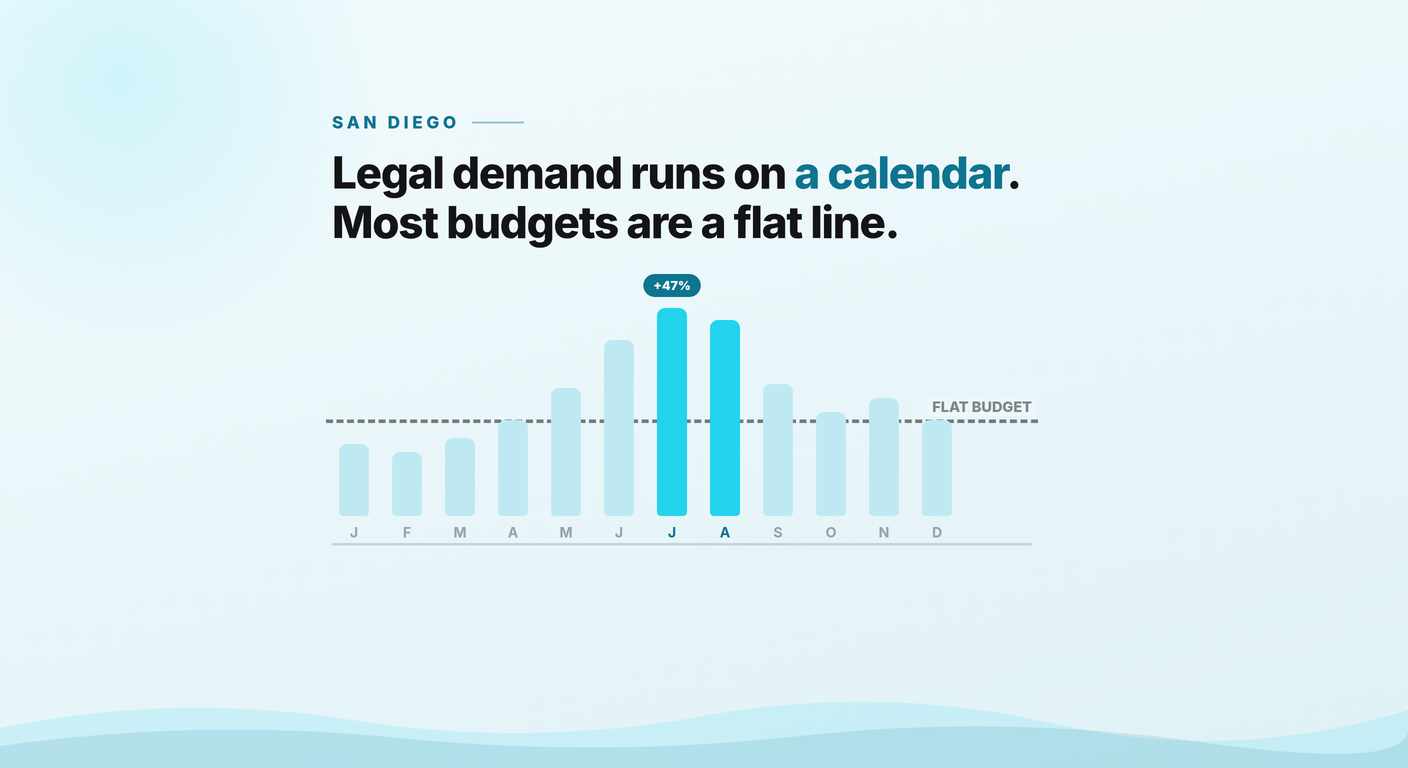
- San Diego legal demand is seasonal in a way no other California market matches. Tourism surges, summer DUI enforcement peaks, and military deployment and rotation cycles move search demand by as much as 47% between quiet and peak periods.
- Most firms spend flat. A fixed monthly budget overpays for clicks in the quiet months and gets outbid in the surge — the same dollars, allocated by the calendar, buy more cases.
- The market rewards fluency over force. Clicks run roughly $14 to $35 — well under Los Angeles or the Bay Area — with about 4,200 firms competing across 18 distinct submarkets. Competition is medium; case quality is high.
- Content has a lead time that ads do not. A page published in July competes for July searches from position forty. The firm that wins DUI season published in spring.
- Spanish search is roughly 38% of the market — a primary market, not a translation task, and still priced like one almost nobody is bidding on properly.
The Misread: "Small LA, Cheaper Clicks"
Out-of-town agencies tend to treat San Diego as Los Angeles at a discount: same playbook, smaller budget, cheaper auction. The prices support the illusion — legal clicks here run roughly $14 to $35 against LA's triple-digit personal injury auctions — and that is usually where the analysis stops.
What the discount reading misses is that San Diego's demand does not behave like LA's at any price. Los Angeles legal search is enormous and comparatively steady; nineteen million people generate car accidents, custody disputes and criminal charges at industrial volume, every month, all year. San Diego's 3.3 million residents share their market with something LA does not have at the same scale: a demand cycle. Tens of millions of visitors move through the county every year. One of the largest military concentrations in the country rotates through deployments and permanent-change-of-station season. Enforcement itself is seasonal. The result is a legal market whose search volume breathes — by as much as 47% between trough and peak.
We covered who searches in San Diego — the military, cross-border and North County structure — in a separate guide. This one is about when they search, because timing is the part of this market almost every budget ignores.
What the San Diego Calendar Actually Looks Like
Sketch the year the way an intake desk experiences it rather than the way a budget spreadsheet assumes it:
- Summer: visitors and enforcement. Tourist season fills the county with people who did not bring a lawyer with them. A visitor injured in a rideshare, arrested after a beach checkpoint, or hurt on a rental scooter searches from a hotel room with zero existing counsel and high urgency — the most convertible traffic a firm can buy. At the same time, DUI enforcement visibly concentrates around summer holidays, and demand for defense work concentrates with it.
- Rotation season: family law's pulse. Military moves cluster in late spring and summer. Each wave carries custody modifications, relocation disputes, lease problems and support questions — matters with dates attached, searched by people working against orders, not preferences.
- Autumn: the business reset. Contract and employment matters pick up as businesses close out fiscal years; estate planning searches build toward year-end as families gather and mortality gets discussed at the dinner table.
- Winter and early spring: the quiet build. The trough — which is precisely when next summer's rankings are won, because content published now has months to accumulate authority before the queries arrive.
None of this is exotic knowledge. Every experienced San Diego intake manager can recite it. The strange part is how rarely the marketing budget reflects what the intake desk already knows.
The Flat Budget Is a Quiet Subsidy to Your Competitors
Here is the arithmetic problem with spending the same amount every month in a market that swings by nearly half.
In the trough, a flat budget buys clicks from a smaller pool of searchers, so more of the spend lands on marginal intent — researchers, price-shoppers, people three months from acting. Cost per click looks fine; cost per case quietly climbs. In the surge, the same budget is suddenly too small: the auction fills with every competitor's ads, impression share drops, and the highest-intent traffic of the year — the hotel-room searcher with a court date — goes to whoever priced the season correctly.
The flat spender loses both halves of the year, in opposite directions, while every monthly report says "consistent."
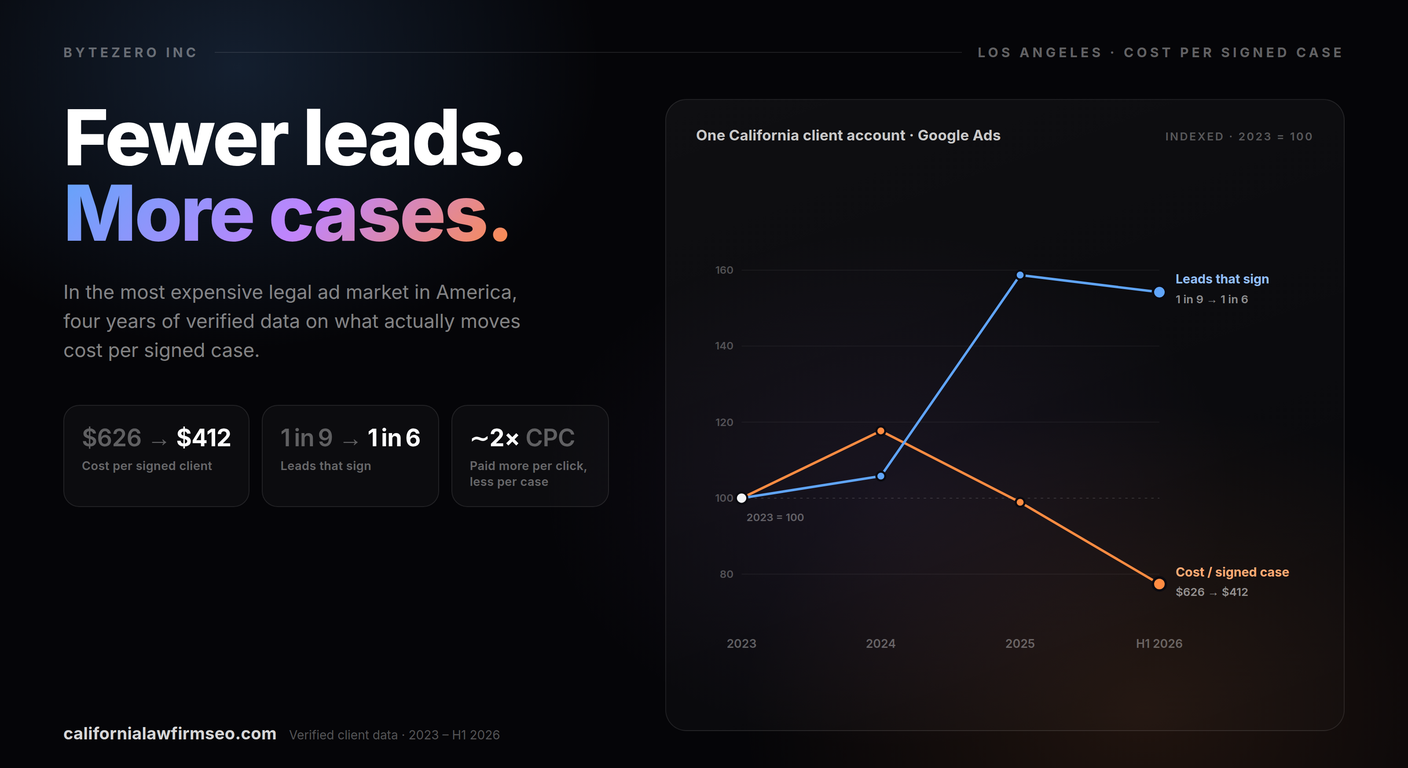
Calendar-aware spending inverts this: pull back where demand is thin, concentrate where it swells, and accept that a good month and a bad month should not cost the same. This is also the argument for judging the whole system on cost per signed case rather than cost per lead — seasonal pacing frequently makes lead counts lumpier while making the year's signed-case economics better, and a lead-count dashboard will read that improvement as a problem.
Content Has a Season Too — and a Lead Time
Paid budgets can move week to week. Rankings cannot. A practice-area page or a "what happens after a DUI checkpoint arrest in San Diego" article published the week demand peaks will spend the season crawling out of obscurity, and arrive at position five in October, when nobody is asking.
The firms that own seasonal queries publish against the calendar, not with it: DUI and visitor-injury content built in spring, rotation-season family law content before the moves cluster, estate-planning material by early autumn. The pattern is the same one that drives practice-area SEO generally — specific pages for specific questions — with one added discipline: the publish date is set by when the searches arrive, minus the months rankings take to mature.
This is also where San Diego's moderate competition becomes a genuine gift. In Los Angeles, seasonal queries are contested year-round by firms with content teams. In San Diego, a meaningful share of seasonal, submarket-specific questions still have no good answer published at all. The first firm to answer them properly tends to keep them.
The 38% Most Budgets Round to Zero
Roughly 38% of San Diego legal search happens in Spanish, concentrated in but not limited to South County. Most firms address this with a translated homepage — which reads to a Spanish-speaking searcher exactly the way a machine-translated menu reads to you.
Treated as a primary market — native-quality pages, Spanish-language ads, intake that can actually conduct the conversation — the Spanish-speaking market behaves like San Diego's paid auction did years ago: real demand, thin competition, prices that have not yet noticed the opportunity. The cross-border dimension of this is covered in the border-market guide; the point here is budgetary. If your marketing plan allocates nothing specific to 38% of the market's searches, the plan has rounded a third of San Diego to zero.
Eighteen Submarkets, One Phone Screen
San Diego resolves into about 18 submarkets that behave like separate towns — La Jolla and Chula Vista are different economies, different case profiles, different price sensitivities; North County inland and coastal barely overlap. With 82% of legal search traffic arriving on mobile, most of these searches resolve through the map pack before a website is ever seen, which makes local-pack presence in the submarkets you actually serve worth more than a county-wide ranking you hold thinly.
The practical consequence: a firm in Carlsbad does not need to outrank downtown billboard firms across "San Diego" queries. It needs to be the obvious answer in its own submarket at the moment its season arrives — a much smaller, much cheaper, much more winnable fight.
What We Would Do First for a San Diego Firm
- Overlay twelve months of intake data on twelve months of spend. Most firms have never drawn the two lines on one chart. The gaps between them are the strategy.
- Rebuild the budget as a curve, not a line. Concentrate paid spend into the practice area's proven season; cut the trough months deliberately rather than letting them dilute the year.
- Publish next season's content now. Whatever the next surge is — rotation season, summer enforcement, year-end planning — its pages need to be live months early.
- Stand up the Spanish-language market properly — pages, ads and intake, not a translation widget.
- Fix the map-pack footprint submarket by submarket, starting where your cases actually come from, not where the county's name is.
- Move the scoreboard to signed cases per season. Seasonal pacing looks erratic on a monthly lead chart and obvious on an annual signed-case one. Judge it on the second.
The full picture of how we work this market — including the submarket and bilingual mechanics — is on our San Diego law firm marketing page. And if you want the version specific to your firm, the free visibility audit maps your search presence, your seasonal exposure, and where the current budget is fighting the calendar instead of riding it.
Questions San Diego Firms Are Asking
Our caseload is steady year-round. Does seasonality still matter?
Signed cases often look steadier than search demand because intake, referrals and court timelines smooth the curve. The seasonality shows up one layer earlier — in what a click costs and how much high-intent volume exists to buy. A steady caseload on top of a swinging market usually means the marketing is quietly overpaying in some months and missing volume in others.
Isn't concentrating budget into a season risky?
It concentrates variance month to month, which feels riskier, while usually lowering it across the year — because more of the spend lands where intent is proven. The discipline that makes it safe is measurement at the signed-case level and a baseline you documented before changing anything.
When should DUI-season content actually be published?
Months ahead of the season — early spring for a summer peak. New pages need time to be crawled, indexed and re-ranked before the queries arrive. Publishing into the peak means renting visibility from ads all season instead.
We already have a translated website. Is that not enough for the Spanish-speaking market?
A translation proves the words exist; it does not make your firm the obvious choice for someone searching in Spanish. Native-quality content, Spanish-language ads and genuinely bilingual intake are what convert that 38% — and they are still cheap relative to the demand because so few firms have built them.
Can a small North County firm compete against downtown advertisers?
Yes — by refusing the county-wide fight. Submarket-level local SEO plus seasonal timing lets a Carlsbad or Escondido firm be dominant where and when its cases actually occur, at a fraction of what a downtown firm spends to be mediocre everywhere at once.
How fast does calendar-based pacing show results?
The paid side moves within the first full season, because reallocating budget acts immediately on auction exposure. The content side compounds across a year as pre-season pages mature into their peaks. Judge the experiment after one complete cycle of your practice area's season, against the baseline year — not month by month.