AI marketing for a California law firm comes down to four jobs: answering calls and chats, running ads, drafting content and reporting results. Tools for each are on sale today. The rules are the same for all of them: the State Bar's 2026 guidance makes the lawyer responsible for every output and restricts what client information goes in.
By ByteZero Editorial Team · Updated November 2, 2026
If you only read one part
- The State Bar of California replaced its 2023 generative AI guidance with a 2026 version, approved by the Board of Trustees on May 14, 2026, that adds agentic AI and names client intake as an example.
- Intake tools touch two California statutes before any ethics rule: the online bot disclosure law (Business and Professions Code section 17941) for web chat, and the all-party consent rule for recording confidential calls (Penal Code section 632) for phone AI.
- Google's AI Max writes ad text and picks landing pages. That text is still your advertising under Rules 7.1 to 7.5.
- Judge every tool on signed clients, not leads. Smart Bidding optimizes for whatever conversion you report.
Free for California firms
Want these numbers for your own office?
We run the same map pack and AI visibility check for your practice and address in California, then show where you stand. No obligation.
Run my free audit →What California firms are searching for
Search demand for AI help is modest and specific. These are 12-month averages from Google Keyword Planner, California, November 2026:
| Search term | Avg monthly searches (CA) | Top-of-page bid range |
|---|---|---|
| ai for lawyers | 390 | $10.64–$58.13 |
| ai for law firms | 210 | $6.88–$43.48 |
| google ai max | 140 | $15.95–$32.52 |
| ai receptionist for law firms | 40 | $13.82–$28.14 |
| ai tools for lawyers | 40 | $18.13–$102.96 |
| ai marketing for law firms | 10 | $12.40–$48.00 |
| ai legal intake | 10 | $26.21–$65.14 |
The bids are high for such small numbers. "Ai tools for lawyers" draws about 40 California searches a month, and the high end of its top-of-page bid range is $102.96. We have no reliable survey of how many California firms use these tools, so this page does not guess. It covers what the tools do according to their own documentation, and what to check before signing.
Intake chat and AI call answering
These tools are sold to cover calls and web chats that arrive when nobody is free. Vendor setup guides describe the mechanics plainly. One AI receptionist's law firm configuration guide lists ten caller types, including opposing party, incarcerated caller and media inquiry. For each, the firm chooses which details are required, which are optional, and whether the call ends, transfers to a person or books an appointment.
Those choices are legal decisions dressed as settings. Three California requirements apply before the tool answers its first call or chat.
- Disclosure online. Business and Professions Code section 17941 makes it unlawful to use a bot online to mislead someone about its artificial identity, knowingly deceiving them in order to incentivize a commercial transaction. A clear, conspicuous disclosure that it is a bot removes that liability, so a website chat bot should say what it is. For a phone AI, saying so up front is good practice.
- Recording. Penal Code section 632 prohibits recording a confidential communication without the consent of all parties. In our view a legal intake call should be treated as confidential. If the tool records calls, get every caller's consent first, for example by announcing it at the start and giving the caller a way to decline.
- Supervision. The State Bar's 2026 Practical Guidance lists "autonomously facilitating client intake" as an example of agentic AI. It says lawyers must not let such a system communicate legal advice or act in a representative capacity without meaningful lawyer supervision and review.
In practice, that means the script collects facts and books time, and it never estimates what a case is worth or whether the caller has one. Our legal intake guide covers the human side of the same process.
AI search check
Is ChatGPT recommending your firm in California?
Our free scan checks how ChatGPT, Gemini and Google AI Overviews describe your firm and which competitors they name instead.
Check my AI visibility →Ad automation: AI Max and Smart Bidding
Google describes AI Max for Search campaigns as a layer on existing Search campaigns, not a new campaign type. Search term matching reaches past your keyword list using broad match and your assets and landing pages. Asset optimization adds text customization, which writes ad copy matched to each search, and final URL expansion, which sends traffic to the URLs on your site Google judges most relevant when that is likely to perform better. The controls include brand exclusions and URL exclusions at the campaign level, and locations of interest at the ad group level.
Two of those features write or choose what a prospective client sees. A generated headline is still a communication about your services, and Rule 7.1 Comment [2] treats an express guarantee of a result as false or misleading. The 2026 definition of "advertisement" in the Business and Professions Code is broad enough to cover a search ad, which we walk through in our SB 37 advertising rules guide. URL exclusions are the practical defence: keep AI Max away from pages carrying case results or fee language that only make sense in context. From September 2026, Google began upgrading Search campaigns that used automatically created assets or campaign-level broad match to AI Max features; our AI Max migration guide covers which settings changed.
Bidding is the other half. Google's help page on Smart Bidding says it uses Google AI to optimize for conversions or conversion value in every auction, and that conversion tracking must be on. The system chases whatever you count. If a form fill is your conversion, it finds form fills. Google's offline conversion import lets a firm send later results, such as a signed engagement, back to the click or call that started it.
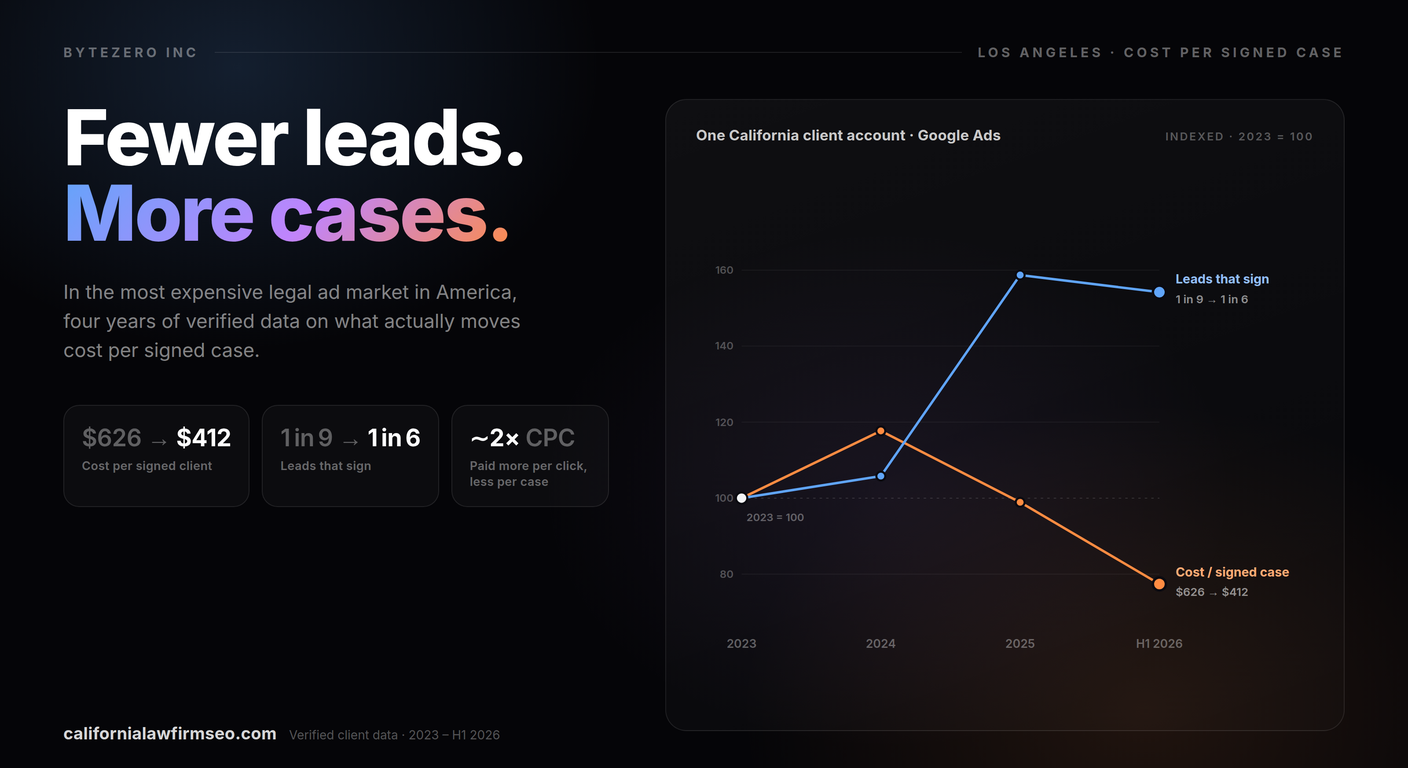
In 2024 the account produced 1,094 conversions and 124 signed clients. In the first half of 2026 it produced 684 conversions and 113 signed clients.
ByteZero, Defend My Biz case study, from the client's own tracking workbook
We judge that account on Letters of Engagement, its signed clients. Cost per signed client fell from $626 in 2024 to $412 in the first half of 2026, while average cost per click roughly doubled, from about $6 to about $12. A report built on clicks or cost per click would have shown that period as getting worse. The signed-client column is the number to hand any automated bidding system.
AI-drafted content
Google does not object to AI writing as such. Its guidance on AI-generated content says appropriate use of AI is not against its guidelines, and that using AI gives content no special gains. Its spam policies draw the line at scaled content abuse, which includes "using generative AI tools or other similar tools to generate many pages without adding value for users".
The State Bar's line is stricter for a law firm. The 2026 guidance says AI systems are known to produce outputs that may be false, misleading, fabricated, incomplete or biased, and that the lawyer remains fully responsible for anything produced with AI assistance. On a practice-area page that means every statute, deadline and fee statement gets checked by a lawyer before it goes live, and nothing in the copy implies a result the firm cannot substantiate (Rule 7.1, Comments [3] and [4]). On the sites we build, AI drafts the copy, we edit it, AI and a contracted paralegal screen it against Rules 7.1 to 7.5, and the firm approves the final wording. Our AI marketing service for California firms covers the rest of the stack.
The client-data question
Marketing tools hold client information too. A call transcript, a chat log or a CRM note about a prospective client can all hold confidential facts. The 2026 guidance is direct: as a general matter, a lawyer must not input any confidential client information into a generative AI tool that may present material risks to confidentiality or security, absent informed client consent to those risks. It also says reasonable efforts require "more than reliance on generalized marketing assurances", and points lawyers to terms of use, privacy policies and vendor documentation.
Agentic tools raise the stakes. The guidance warns that systems connected to email, calendars, document management or client files may have persistent access to large volumes of confidential information. It says a lawyer must not deploy one in a way that permits autonomous external transmission of client information without safeguards and human review. In our reading, an AI assistant that reads the intake inbox and sends follow-up emails on its own fits that description.
Supervision is the last piece. The guidance says managerial lawyers should set clear policies on generative and agentic AI and give staff periodic training. Outside vendors come in through Rule 5.3: Rule 7.2 Comment [3] names marketing vendors such as website designers and points to Rule 5.3 for the duty to supervise nonlawyers who prepare marketing materials.
What to verify before buying
| Ask the vendor | Why it matters in California | Source |
|---|---|---|
| Are inputs, transcripts or chats used to train or improve the model? | Inputs may become part of another user's response; client confidences need protection | State Bar 2026 Practical Guidance, duty of confidentiality |
| Where are recordings and transcripts stored, and for how long? | The guidance points lawyers to retention and security protocols, not marketing claims | State Bar 2026 Practical Guidance |
| Does the web chat bot say it is a bot, and can the wording be edited? | A clear, conspicuous disclosure avoids liability under the online bot statute | Bus. & Prof. Code § 17941 |
| Does the phone greeting get consent to recording before any facts are given? | Recording a confidential call needs every party's consent | Penal Code § 632 |
| Can the system send messages or files outside the firm without a person approving them? | Autonomous external transmission of client information needs safeguards and human review | State Bar 2026 Practical Guidance |
| Who approves generated ad text and landing page choices? | Ads are communications under Rule 7.1; an express guarantee of a result is false or misleading | Rules of Professional Conduct 7.1–7.5 |
| Can signed engagements flow back into Google Ads? | Smart Bidding optimizes for the conversions you report | Google Ads Help: Smart Bidding; offline conversion imports |
The State Bar is also considering rule amendments on AI. Its proposed changes to Rules 1.1, 1.4, 1.6, 3.3, 5.1 and 5.3 went out for a second public comment period that closed on August 6, 2026. Check their status before you write a firm AI policy.
Before you call
Can a California law firm use an AI receptionist?
Yes, with conditions. The State Bar's 2026 guidance lists autonomous client intake as agentic AI and says lawyers must not let such systems give legal advice or act for the firm without meaningful lawyer supervision and review. Get every caller's consent before recording, as Penal Code section 632 requires for confidential calls; as good practice, tell callers they are talking to AI; and keep the script to collecting facts and booking time.
What did the State Bar's 2026 generative AI guidance change?
It replaced the November 2023 version and adds guidance on agentic AI, systems that act without step-by-step prompting. It keeps the core duties: competence, confidentiality, supervision, communication with clients and candor to the court. It says the more autonomy a system has, the stronger the lawyer's oversight must be.
Is AI-written content bad for law firm SEO?
Not by itself. Google says appropriate use of AI is not against its guidelines and gives content no special advantage either way. Its spam policies target mass-produced pages that add no value. For a law firm, the bigger risk is accuracy: the State Bar says the lawyer is responsible for every AI output.
Do AI-generated Google Ads have to follow attorney advertising rules?
Yes. A headline written by AI Max's text customization is still a communication about the firm's services under Rule 7.1, and California's statutory definition of an advertisement covers electronic communications. Use URL exclusions and review the generated assets regularly.
How should a firm measure AI marketing tools?
On signed clients and cost per signed client, not leads or conversions. Smart Bidding optimizes for whatever conversion action you report, so importing signed engagements as offline conversions gives the system a better target than form fills.
Book a free strategy call and we'll review the AI tools in your intake and ad accounts against the checklist above.