The Traditional Build Is Officially Broken
In California's hyper-competitive legal markets — starting in the pressure cooker of Los Angeles — the traditional approach to law firm website design is officially broken.
For years, managing partners in Century City, Downtown LA, and the San Fernando Valley paid traditional agencies $15,000 to $35,000+ and waited three to six months for a custom WordPress website. By the time those sites launched, the code was bloated, mobile load speeds were sluggish, and the SEO architecture had been slapped on as an afterthought.
Worst of all, those legacy sites were built solely for Google's traditional blue links — leaving them completely invisible to the modern client who asks ChatGPT, Perplexity, Claude, or Google AI Overviews to recommend an attorney. An AI answer names two or three firms, and there is no position four. A site that only knows how to rank cannot get cited.
This is the 2026 playbook for what replaces that model: AI website development for law firms — what it actually means, what it must include, and how to tell an engineering pipeline from a template with a chatbot.
What "AI Website Development" Actually Means
The phrase is currently the most misused in legal marketing, so let's define it by what changes. Three things — none of which is "a robot writes your website."
1. Pattern analysis before design
Instead of one designer's taste, the build starts from analysis of hundreds of top-performing law firm websites in your practice area — which layouts convert, which content structures rank, which intake flows produce booked consultations. AI compresses months of agency discovery into days. The output isn't the site; it's the evidence the site gets built from.
2. Template systems instead of hand-built pages
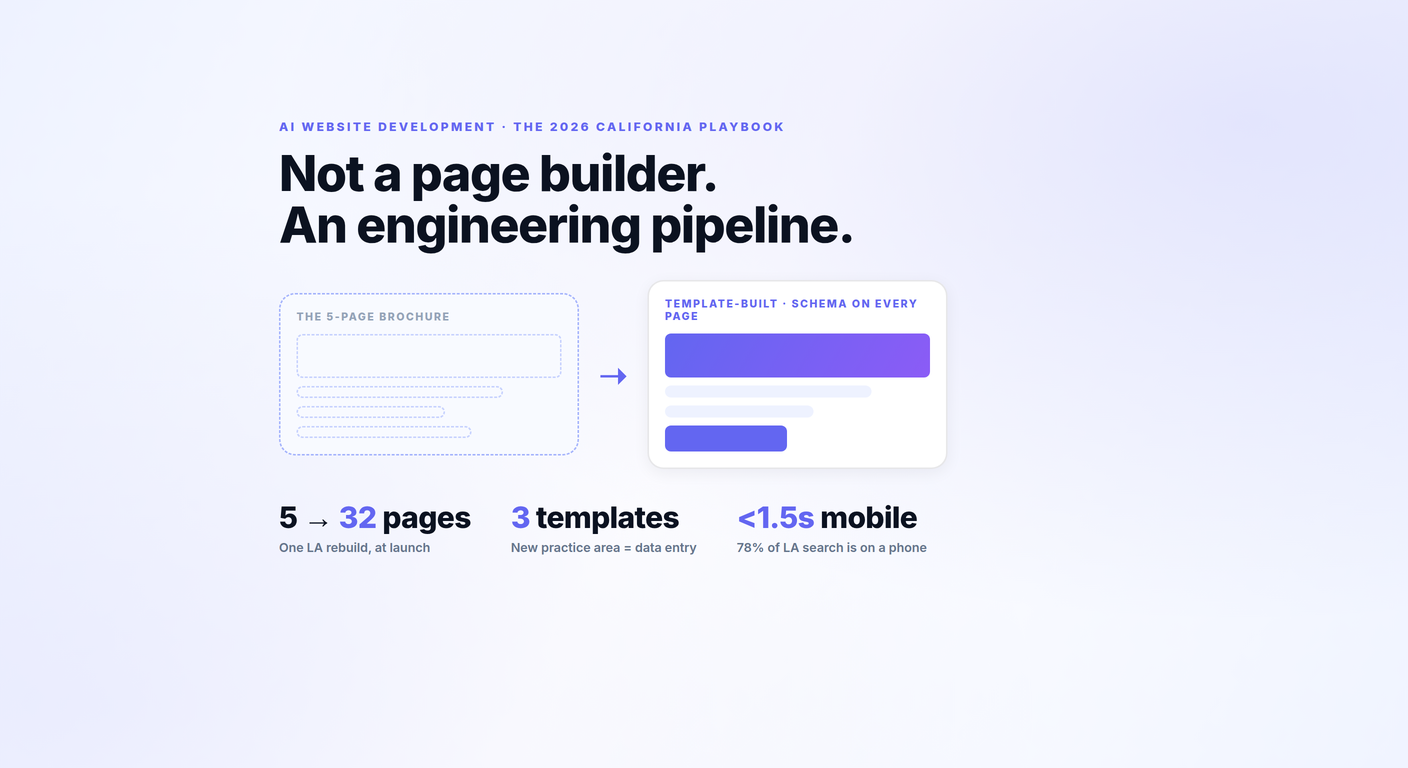
This is the part that matters most and gets explained least. A traditional build produces N hand-made pages, and page N+1 is a new invoice. An AI-engineered build produces templates — pillar, matter, article — so the site scales as data instead of labour. On one Los Angeles criminal defense rebuild, three reusable templates took a five-page WordPress brochure to 32 pages at launch, with JSON-LD schema on every page — and a fifth practice area became a data entry, not a project. The sourced record is in our case studies.
3. Days instead of months — with human review where it counts
AI-accelerated workflows take design generation and content structuring from a quarter to roughly a week. But acceleration is only half the model: every page still passes attorney-level review for legal accuracy and California State Bar compliance before launch, because AI can draft a DUI page in a minute and confidently get the statute wrong.
Built for Two Audiences: Clients and Machines
A 2026 law firm website has two readers. The human who decides whether to call, and the machine that decides whether to recommend you at all.
For the human: modern design, a sub-1.5-second mobile load, and a conversion path that puts a tappable phone number where the thumb already is. For the machine: LegalService, Attorney and FAQPage schema on every page, extractable answers, and entity-consistent structure — the raw material ChatGPT, Perplexity and Google's AI surfaces cite from. That second discipline is generative engine optimization, and the build is where it starts; retrofitting schema onto a bloated theme is how firms end up paying for the same site twice.
The California Standard: What Every Build Must Include
- Sub-1.5s mobile load, measured on cellular — not on office Wi-Fi. Most firm sites we audit take five to eight seconds; the majority of visitors give up around three. (Why this signs cases: site speed and conversions.)
- A template system. Ask the vendor directly: "If I add a practice area next year, is that a build or a data entry?"
- JSON-LD schema on 100% of pages — LegalService, Attorney, FAQPage, Breadcrumb. View source and check; invalid or missing schema is silent.
- Bilingual architecture where your market demands it — native-quality Spanish, hreflang, and intake that answers in both languages.
- CRPC 7.1–7.5 compliance review by a human — testimonial disclosures, specialisation language, case-result framing. In California this is an architectural constraint, not a footer disclaimer.
- WCAG 2.1 AA accessibility — an ADA exposure question and clean crawlable structure in one.
- Conversion tracking wired at launch, so from day one you can measure the only number that matters: signed cases by source. (The argument: the LA lead trap.)
Starting Where It's Hardest: Los Angeles
Every part of this playbook is stress-tested in LA first, because LA is where weak builds fail fastest. More than 14,000 firms compete across the county. The audience is the most design-literate in the country — a dated template reads as a discount signal in seconds. 78% of LA legal search happens on a phone, with crisis searches clustering after 11 PM, which makes load speed an intake metric. And 47% of LA County speaks Spanish at home, which makes bilingual-by-design a market requirement, not a feature.
A build that survives Los Angeles works in Sacramento, Fresno and San Diego on the same architecture — which is exactly why we anchor the playbook there. How we run it in that market: Los Angeles law firm marketing.
The Honest Section: A Documented LA Rebuild
The rebuild cited above deserves the unvarnished version, because it shows both the power and the limits of the model. Three complete design directions were built and rejected before the fourth became the site — then roughly fifteen further rounds of client direction on palette, type and identity. AI made each round fast; it did not make the client's judgement optional. And at the time of writing that site had not yet launched, so no traffic or ranking claims are attached to it — none are implied. Demand the process from any vendor, not just the portfolio: an agency that shows only finished wins is hiding the part that determines whether they can take direction.
AI Website Development for Law Firms — FAQ
How fast can a California firm launch?
Most AI-accelerated builds launch in about a week from kickoff — days, not months. Complex rebuilds with brand work take longer, and honest vendors say so up front.
What does it cost against a traditional build?
Traditional California agency builds commonly run $15,000 to $35,000+ over three to six months. AI-engineered builds land at a fraction of that in both money and time — custom-quoted to firm size and scope, because a solo estate planner and a ten-attorney PI firm are not the same project.
Will an AI-built site rank on Google and get cited by AI?
The build is the foundation, not the ranking: URL structure, schema, Core Web Vitals and citable content architecture from day one give both SEO and GEO something to compound on. Rankings and citations then come from the ongoing work — content, authority, reviews — which is a separate discipline in a market like LA.
Is AI-generated legal content safe to publish?
Only with attorney review. Statutes, deadlines and legal claims need human verification against current law — that review step is the difference between AI-accelerated and AI-negligent.
The right first step is the audit, not the contract: get a free audit of your current site's speed, schema and conversion path, and see the full build model on our AI website development for California law firms page.