PPC for law firms means paying for placement each time a prospective client clicks or calls. In California the three channels covered here are Google Search ads, billed per click; Google Local Services Ads, billed per valid lead; and Meta ads on Facebook and Instagram. Each one is an attorney advertisement, so Rule 7.1 and Business and Professions Code § 6157.2 apply.
Key Takeaways
- Clicks are priced by practice area. In Keyword Planner for California (October 2026), the high-range top-of-page bid for “car accident attorney” is $922.97; for “estate planning attorney” it is $19.92.
- Three channels, three billing units. Search ads charge per click, Local Services Ads charge per valid lead, and Meta ads buy reach with people who are not searching yet.
- A missed call can still be a billed lead. Google counts a missed call during business hours as valid if the caller stays on the line for more than 20 seconds.
- Every ad is regulated copy. No guarantees, no “quick settlement” claims, a costs disclosure with any “no fee unless we win” offer, and a responsible lawyer or firm name plus an office city or county in the ad.
- Keep a copy for a year. Business and Professions Code § 6159.1 puts that duty on whoever pays for the ad.
By ByteZero Editorial Team · Updated October 28, 2026
General marketing information, not legal advice. Confirm advertising questions with your ethics counsel.
A car accident click in California can cost a law firm more than $900 at the top of Google. Not a case, a click. That number comes from Google’s own Keyword Planner, which we pulled for this guide, and it is the reason PPC either pays for itself at a firm or quietly eats the marketing budget. The ad is only part of it. The rest is which channel the firm picked, how its phones are answered, and whether the copy survives a State Bar complaint.
What Does PPC Mean for a Law Firm?
PPC (pay-per-click) means the firm pays the ad platform only when someone acts on the ad, usually a click, and the price is set in a live auction against other advertisers bidding on the same search.
On Google, the auction runs every time someone in your target area types a phrase such as “dui lawyer” or “wrongful termination lawyer”. The firm chooses the phrases, the geography and a budget. Google decides who shows and at what price. When people say “PPC for lawyers” they may mean Google Search ads alone, but Local Services Ads and paid social sit in the same budget line, and they behave very differently.
One quirk worth knowing before you plan a campaign: Keyword Planner reports volume for a phrase and its close variants together. When we pulled “ppc for lawyers”, “ppc for attorneys” and “attorney ppc” for the United States, all three came back with the identical row: 590 searches a month. In California, “personal injury lawyer” returned 27,100 a month while “personal injury attorney” returned no volume at all. Read that as one pool of demand filed under one spelling, not as proof that nobody types “attorney”.
What PPC Costs California Law Firms in 2026
California click prices range from a few dollars to several hundred, depending on the practice area. The table below is Keyword Planner data for the California location setting, pulled on October 27, 2026.
| Keyword (California) | Avg. monthly searches | Top-of-page bid, low range (USD per click) | Top-of-page bid, high range (USD per click) |
|---|---|---|---|
| car accident attorney | 5,400 | $70.00 | $922.97 |
| motorcycle accident lawyer | 2,400 | $77.13 | $429.00 |
| personal injury lawyer | 27,100 | $69.89 | $236.00 |
| lemon law attorney | 5,400 | $43.98 | $176.50 |
| dui lawyer | 27,100 | $20.45 | $171.60 |
| wrongful termination lawyer | 8,100 | $31.06 | $112.00 |
| criminal defense attorney | 6,600 | $9.76 | $87.39 |
| family law attorney | 27,100 | $8.36 | $44.62 |
| probate attorney | 5,400 | $11.78 | $35.90 |
| immigration lawyer | 27,100 | $5.63 | $23.55 |
| estate planning attorney | 33,100 | $4.40 | $19.92 |
Source: Google Ads Keyword Planner, October 2026, location California, English, USD. Searches are 12-month averages.
How to Read the Bid Range
The two bid columns are not a price list. Google’s Keyword Planner documentation defines the low range as an approximation of the 20th percentile of what advertisers have historically paid for a top-of-page position, and the high range as the 80th percentile, both for the location you selected. So a firm bidding $70 on “car accident attorney” is at the cheap end of the auction, and a firm paying $900 is not unusual.
The spread matters more than either end. “Car accident attorney” carries a 13-fold gap between the two columns; “estate planning attorney”, under five-fold. A wide spread means some advertisers pay many times what others pay for the same top position. A firm bidding near the low end wins fewer of those auctions, but it is still in them, and tight geography plus a staffed phone line decide what each click is worth.
A car accident click in California can cost more than $900 at the top of Google. That is the price of a click, not a case. (Google Ads Keyword Planner, October 2026)
Demand Swings Hard
Averages hide the swings. California searches for “ppc for law firms” average 320 a month, but the monthly figures over the last year ran from 10 to 1,600. Budget by month, not by the yearly average.

Google Ads for Lawyers: Paying by the Click
Google Search ads put a firm’s text ad above the organic results for the phrases it chooses, and the firm pays each time someone clicks through or taps to call.
Search ads give the most control of the three channels: you pick every keyword, write every headline and decide which ZIP codes see the ad. That control is also the risk. A personal injury campaign with loose matching can pay for searches like “personal injury lawyer salary” or “personal injury paralegal jobs”. A negative keyword list (jobs, salary, school, paralegal, free legal aid, template) belongs in the account before the first dollar is spent, and the search terms report should be read weekly for the first month.
Call Tracking and California’s Recording Law
If your PPC setup routes calls through a tracking number and records them for quality review, California Penal Code § 632 applies. It makes it a crime to record a confidential communication without the consent of all parties, with fines up to $2,500 per violation for a first offense, or up to a year in jail. The caller needs to hear a disclosure before the conversation starts. Ask your vendor where that message plays and test it yourself from a cell phone.
Where AI Max Fits
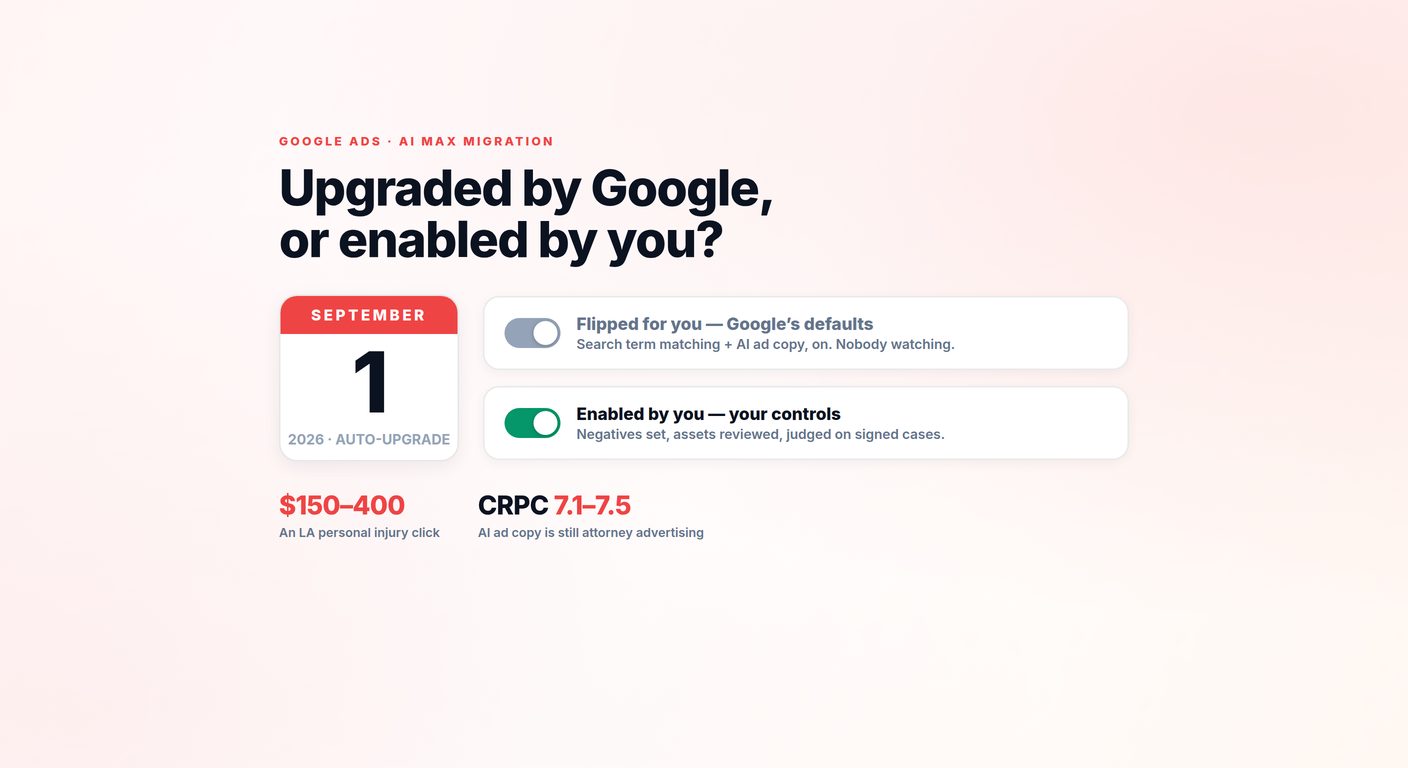
Google’s AI Max for Search campaigns can match queries beyond your keyword list and generate ad text from your landing pages and existing ads. Generated copy is still your firm’s advertisement, so every generated headline needs the same review as one you wrote. We cover the settings in our breakdown of Google AI Max for law firms.
Local Services Ads for Lawyers: Paying by the Lead
Local Services Ads charge a firm per valid lead, such as a call or message, rather than per click, and they require the firm to pass Google’s screening and verification before ads run.
Google’s own explanation of how leads work spells out what counts. A call you answer is a lead. So is a text, an email, a voicemail, and a missed call during your business hours where the caller stays on the line for more than 20 seconds. That last rule can cost firms money: a front desk that lets the phone ring through lunch is buying leads it never speaks to.

Three more details from the same page shape how LSA should be run:
- Follow-up calls or messages from the same number or email within 15 days of a charged lead are not charged again.
- Google reviews lead quality over a 30-day period and credits leads it finds to be poor quality, duplicate or invalid. Each lead also carries a feedback survey.
- Spend is set as an average weekly budget, with a monthly maximum the account will not exceed.
The trust badge has a new name. LSA profiles now carry a Google Verified badge, and Google’s help page on the older Google Screened badge says existing advertisers who completed verification earn it automatically. Google’s eligible-services list includes bankruptcy, business, contract and criminal lawyers, among other categories.
Meta Ads: Paying for Attention Before the Search
Meta ads on Facebook and Instagram reach people who are not searching for a lawyer yet, which makes them a channel for recognition and follow-up rather than for the person who needs counsel today.
They suit practices where the decision is slow and personal: estate planning, family law, immigration, employment. If you run Spanish-language creative there, a specific rule applies. Rule 7.1’s comment [5] bars a communication implying the firm can provide legal services in a language other than English unless it actually can, or the ad states, in that language, the employment title of the person who speaks it. A Spanish ad that leads to an English-only intake line is a compliance problem, not just a conversion problem.
Google Ads vs Local Services Ads vs Meta
Each channel answers a different question about the prospective client. This is how they compare for a California firm.
| Channel | What you pay for | Who sees it | Setup gate | Fits best when |
|---|---|---|---|---|
| Google Search ads | Each click (USD per click, set at auction) | People searching your keywords now | Ads account and billing | You want control over keywords, copy and ZIP codes |
| Local Services Ads | Each valid lead (call, message, voicemail, booking) | People searching eligible legal categories nearby | Google screening and verification | Your phones are staffed through business hours |
| Meta ads | Reach and engagement on Facebook and Instagram | People matched by location and audience settings, not searching | A Meta ad account | The decision is slow and trust drives it |
For the bigger budget question of paid search against organic rankings, see our comparison of Google Ads vs SEO for California law firms.
California Ad Rules Every PPC Campaign Must Meet
Every paid ad a California firm runs is an advertisement under Business and Professions Code § 6157, which covers communications “through any written, recorded, or electronic means”, so a 30-character headline carries the same duties as a billboard.
Section 6157.2 lists what an advertisement may not contain. Four items bear directly on PPC copy:
- Guarantees. No guarantee or warranty of success, under § 6157.2(a)(1). Rule 7.1’s comment [2] treats an express guarantee as false or misleading.
- “Fast cash” language. A headline promising money within days runs into § 6157.2(a)(2), which bars statements that the lawyer can generally obtain immediate cash or quick settlements.
- Contingency without costs. An ad offering representation on a contingent basis must say whether the client pays costs advanced when there is no recovery, under § 6157.2(a)(4); if the client will not, no disclosure is required. Rule 7.1’s comment [3] goes further: any ad that states or implies “no fee without recovery” must expressly disclose whether or not the client will be liable for costs.
- Paid awards. An award or recognition can be mentioned only if it was not conferred by membership and the organization did not charge or solicit a fee for it, under § 6157.2(a)(6).
Name and Office City in the Ad
Section 6157.2(b) requires an advertisement to display the name of a responsible California lawyer or the law firm, and the city, town or county of at least one bona fide office or the State Bar address of record. Rule 7.2(c) separately requires the name and address of at least one lawyer or firm responsible for the content. The statute’s express allowance for character-limited platforms, § 6157.2(b)(3), is written for joint advertisements that link to a landing page. A single firm is safer putting its name and office city in the ad itself. Section 6157 itself was amended by SB 37, effective January 1, 2026; our guide to California attorney advertising rules after SB 37 walks through the changes.
Keep a Copy for One Year
Section 6159.1 requires whoever pays for an advertisement soliciting legal employment to keep a true and correct copy for one year. Responsive search ads make that harder than it sounds: an ad can hold up to 15 headlines and 4 descriptions, and Google assembles them into different combinations as it serves. The practical answer is a dated export of every asset in every ad, saved each time the copy changes, plus screenshots of the LSA profile and each Meta creative.

PPC Management for Lawyers: Measure the Signed Case
The number that decides whether PPC works is cost per signed matter, not cost per click or cost per lead, so tracking has to follow each inquiry from the ad to the fee agreement.
In practice: one tracking number for Search ads, a separate source tag on every Meta lead form, an intake sheet that asks “how did you hear about us” before anything else, and a monthly session where each new fee agreement is matched to the channel that produced the first contact. Our guide to legal intake covers the intake side, and our post on lead generation for lawyers covers comparing channels on that basis. Results depend on the firm, its practice area and its market.
Whoever runs the account, the lawyer still owns the copy. Rule 7.2’s comment [3] permits paying vendors for marketing work and points to Rule 5.3 for the duty to supervise nonlawyers who prepare it. Keep the Google Ads and LSA accounts in the firm’s name, with admin access the firm controls. Our AI marketing service for California law firms includes Google Ads and Meta Ads management.
Frequently Asked Questions
What does PPC mean in law firm marketing?
PPC stands for pay-per-click: the firm pays an ad platform each time someone clicks its ad, at a price set by auction. For law firms it can mean Google Search ads, Local Services Ads (billed per lead) and Meta ads.
How much does PPC cost for a law firm in California?
It depends on the practice area. Keyword Planner for California in October 2026 shows a top-of-page bid low range of $70.00 and high range of $922.97 per click for “car accident attorney”, against $4.40 and $19.92 for “estate planning attorney”. Your actual cost depends on your bids, ad quality and competition.
How are Local Services Ads charged for lawyers?
Per valid lead, not per click. Google counts answered calls, messages, voicemails and missed calls during business hours where the caller stays on more than 20 seconds. Follow-ups from the same contact within 15 days are not charged again.
Can a California law firm advertise “no fee unless we win” in a Google ad?
Only with a costs disclosure. Business and Professions Code § 6157.2(a)(4) requires a contingency offer to say whether the client is responsible for costs advanced when there is no recovery, unless the client will not be. Rule 7.1’s comment [3] is stricter: “no fee without recovery” wording must expressly say whether or not the client will be liable for costs, even when the answer is no.
Do Google ads for lawyers need the firm name and city?
Yes. Section 6157.2(b) requires the name of a responsible California lawyer or the firm and the city, town or county of at least one office, or the State Bar address of record. Rule 7.2(c) also requires the name and address of a responsible lawyer or firm.
How long must a law firm keep copies of its ads?
One year. Business and Professions Code § 6159.1 requires whoever pays for an advertisement soliciting legal employment to keep a true and correct copy for one year. For search ads, save a dated export of every headline and description.
Is PPC or SEO better for law firms?
Neither wins everywhere. PPC buys visibility the day it launches and stops when spend stops; SEO takes months and keeps working. Weigh both by cost per signed case, as we do in our Google Ads vs SEO comparison.