What Is Changing on September 1
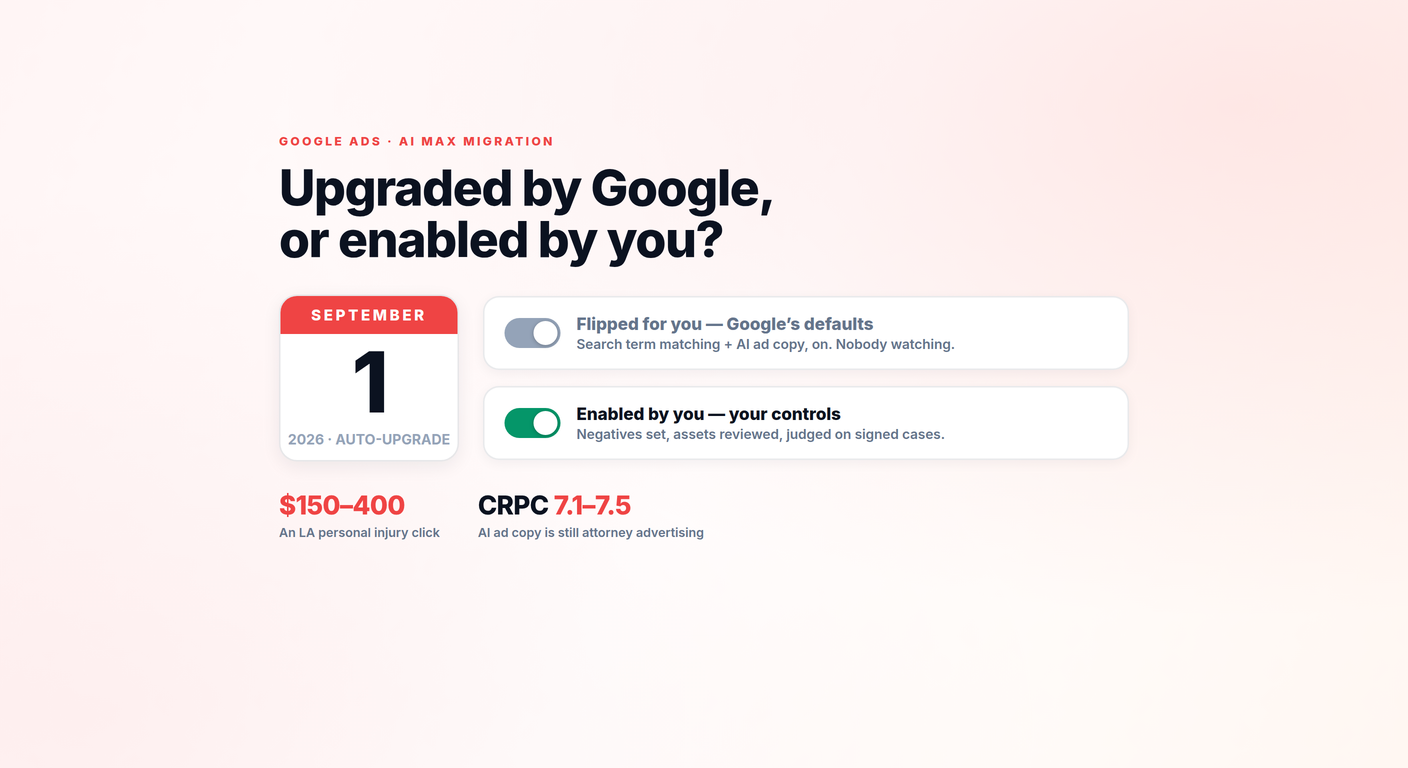
Google is folding two long-standing Search campaign features into AI Max, its campaign-level AI suite — and from September 1, 2026, eligible Search campaigns will be upgraded automatically:
- Campaigns using Automatically Created Assets (ACA) get AI Max with search term matching and text customisation enabled by default.
- Campaigns using the campaign-level broad match setting get AI Max with search term matching enabled by default.
Google's stated goal is for migrated campaigns to behave much as they do today, and there are two ways to stay in charge of the transition: enable AI Max yourself before the deadline, with the controls set your way, or switch off the legacy features and stay out of the migration entirely. Both are defensible. Waking up in September to a silently reconfigured account is not — and for a law firm, the stakes of a silent settings change are higher than for almost any other advertiser.
Why Attorney PPC Is a Special Case
Attorney PPC already runs on the most expensive clicks in America. A Los Angeles personal injury click costs $150 to $400 — one reason we treat Los Angeles law firm marketing as its own discipline. AI Max's search term matching lets Google's models reach past your keyword list to queries they predict are relevant. For an e-commerce store paying $1.20 a click, that is a cheap experiment. At legal CPCs, it is a five-figure monthly decision made by a system that has never seen your intake numbers.
Two more things make law firms unusual. Legal queries sit next to huge volumes of near-miss intent — research-stage questions, DIY form seekers, students, opposing parties — so automated expansion can fill an account with clicks that become consultations and never become engagements. And AI Max's text customisation generates headlines from your landing pages, which means a model is now writing attorney advertising that answers to Rules of Professional Conduct 7.1–7.5 — the false-or-misleading standard, specialisation language, outcome implications. It is still your ad, under your bar number, whoever wrote it.
The Pros: A Fair Reading of Google's Move
- Coverage you cannot buy manually. Search behaviour is drifting toward long, conversational, AI-assisted queries that no keyword list anticipates. Search term matching is built to catch that tail.
- More signal for bidding. Smart Bidding performs better with more query volume to learn from, and consolidation feeds it.
- Less production labour. Automated asset generation shrinks the copywriting treadmill that quietly eats small-firm ad budgets.
- Real controls for early movers. Brand inclusions and exclusions, URL controls and geo-intent settings are all configurable — if you opt in deliberately rather than getting migrated.
- A forcing function. A hard date makes firms finally audit accounts that have run on autopilot for years. That audit has value whatever you decide.
The Cons: What Can Go Wrong
- Budget drift at brutal prices. Expansion errors that cost an online store pennies cost a law firm a filing fee per click.
- Compliance exposure. AI-written headlines are bar-regulated attorney advertising with no built-in bar review.
- Less visibility. Automation has historically arrived alongside thinner search-term reporting, which makes waste harder to prove.
- The wrong scoreboard. The system optimises toward conversions it can see — form fills and calls — not the signed cases that actually pay for it. Our framework for that gap is in Google Ads vs SEO for law firms.
- Asymmetric incentives. Broader matching reliably benefits the auction house. It only sometimes benefits the advertiser.
If You Manage Your Own Google Ads
Plenty of California attorneys — especially solo and small firms in competitive metros like San Diego — run their own accounts, and PPC for law firms is absolutely manageable in-house. But this migration is the moment to be deliberate:
- Find your exposure. Check each Search campaign for ACA or campaign-level broad match — that is the auto-upgrade cohort, and Google is surfacing an upgrade notice inside affected accounts.
- Decide before Google does. Opt in on your own terms, or switch the legacy features off before September 1.
- Freeze a baseline. Export the search terms report, record conversion and signed-case rates, screenshot settings. If performance moves in September, you want a before picture that isn't from memory.
- Build the guardrails first. Brand exclusions, URL controls and a serious negative keyword list are what make search term matching survivable at legal CPCs.
- Calendar a weekly review. Fifteen minutes on the search-terms and asset reports — reading generated copy with CRPC 7.1–7.5 in mind, not just click-through rate.
- Score it on signed cases. If the added reach doesn't produce engagements at equal or better cost per signed case, roll it back. The reach was the product Google sold itself.
If an Agency Runs Your Account: What to Watch
Google Ads management for lawyers is exactly the kind of service this migration quietly audits. The first test costs nothing: did your agency brief you about September 1 before you had to ask? If not, you've just learned how actively your law firm ads management is being watched.
Then ask five questions, and expect specific answers:
- Which of our campaigns are in the upgrade cohort, and is your plan a deliberate opt-in or an opt-out?
- Who reviews AI-generated headlines for attorney-advertising compliance, and how often?
- Will you show me search-term-level spend after the migration — not just totals?
- What baseline are you documenting now, so September performance can be compared honestly?
- Will you report cost per signed case — not clicks, not conversions?
One red flag deserves its own line: an agency that welcomes every automation feature uncritically is often outsourcing its own job to Google. "It's what Google recommends" is not a strategy; it's a settings page.
Where We Land
We run paid search and lawyer marketing for California firms every day, and our position is neither panic nor cheerleading. In one documented employer-defense engagement, cost per signed client fell from $626 to $412 by narrowing onto high-intent terms and accepting a doubled cost per click — the full dataset is in the LA lead trap. AI-driven bidding fed with real signed-case data is genuinely powerful; AI-driven expansion fed with form-fill data is how accounts get expensively busy. The difference is not the AI. It's what you let it optimise toward — the argument at the heart of our AI marketing management for California law firms.
AI Max for Law Firms — Quick Questions
We use manual keywords and no ACA. Are we affected?
Not by this automatic migration. But AI Max is where Google is consolidating Search features, so the deliberate-adoption question is when, not whether.
Is opting out a mistake?
No — disabling the legacy features is reasonable if you can't monitor closely right now. Treat it as a deferral, not a strategy, and use the time to set up signed-case tracking so a future adoption can be judged honestly.
Is AI-generated ad copy a real compliance risk?
Yes. Generated headlines are your advertising under CRPC 7.1–7.5 regardless of who — or what — wrote them. Review the asset report weekly, or keep text customisation off. Since January 1, 2026 they are also regulated under SB 37, which made your website and ads a statutory liability — including copy a vendor or a model produced on your behalf.
If you'd rather not face September 1 alone: get a free audit. We'll map which of your campaigns are in the upgrade cohort, what the migration changes for your account, and what your current cost per signed case actually is.