OpenAI dots for California law firms can help keep a content calendar, research queue and review checklist moving between meetings. Astra for Law adds a separate legal research and analysis capability for eligible users. A useful way to combine them is a supervised handoff: organize the work, prepare a sourced draft, then have a lawyer approve what leaves the firm.
That is a workflow proposal, not a claim that a dot automatically includes Astra for Law. This guide explains the distinction and gives a California firm a practical starting point. Product information was checked on September 30, 2026. The examples are hypothetical; they are not client results or a tested integration.
Key Takeaways
- Start with public website content and a restricted source folder. Client matters need a separate access decision.
- Use dots to coordinate recurring work. Confirm Astra for Law access separately before planning legal research around it.
- Give every draft a source list, an owner and an approval status. A completed draft is not permission to publish.
- Measure review effort and factual corrections before expanding the workflow. More articles alone is a poor success measure.

Two tools, two different responsibilities
OpenAI describes dots as agents that continue work between conversations. They can use permitted connected tools and bring decisions back to their owner. Availability is rolling out to eligible accounts. That makes a dot relevant to an ongoing editorial queue, where the work includes gathering inputs, preparing drafts and tracking what still needs review.
Astra for Law combines GPT-6 Astra with a legal search index and instructions for legal work. OpenAI describes initial access for selected US law firms through Trusted Access and Codex, with API availability coming later. Eligible lawyers and people under their supervision should confirm access with OpenAI. A normal Astra model selection does not establish access to the legal configuration.
Keep the handoff explicit. A marketing coordinator can prepare an issue brief from approved public materials. An authorized lawyer can use the available legal research environment to examine the issue. Only the lawyer-approved public explanation returns to the editorial queue. This avoids making a marketing agent the custodian of an entire matter file.
| Responsibility | Suggested output | Decision owner |
|---|---|---|
| Recurring content coordination | A queue of page updates, sources and missing approvals | Marketing lead |
| Legal research, if Astra for Law is available | Candidate authorities and analysis for independent checking | Supervising lawyer |
| Website publication | An approved page with an accurate date and review record | Authorized publisher |
| Client-specific advice | A lawyer's advice through the firm's approved channel | Responsible attorney |
Start with the California content backlog
A good first assignment is narrower than “manage our marketing.” Choose a practice page that already exists and collect the public sources supporting it. For a Los Angeles employment practice, that might be a page explaining the firm's services, its attorney biographies and a short list of official sources selected by the attorney. The exercise is to identify unsupported statements and stale references, not to produce a new legal opinion.
Use an inventory with one row per claim. Record the page URL, exact sentence, supporting source, source date, proposed correction and reviewer. A claim such as an attorney credential belongs with the person who can verify that credential. A procedural explanation belongs with a lawyer. A broken contact link belongs with the website team. Sending everything to the same inbox slows the work and obscures responsibility.
Our California law firm content strategy service is the relevant marketing starting point. A content workflow should support real practice pages and client questions. It should not create a separate page for every neighborhood unless the firm has something useful and accurate to say about that location.
Take a hypothetical firm serving Sherman Oaks and downtown Los Angeles. Its two pages may need different directions, office details and descriptions of available consultations. They do not need two lightly rewritten copies of the same legal explanation. Give the agent the actual office facts and require it to flag missing facts rather than complete them from its own assumptions.
Build a brief before asking for a draft
The brief should answer five questions: who is reading, what decision they need to make, which practice the page describes, which sources are approved, and who can approve the finished text. Attach a list of prohibited claims specific to the firm. Examples include an outcome guarantee, an unsupported award or language implying a credential that has not been verified.
Then ask for a draft that separates facts from suggestions. A useful response includes the proposed text, a source beside each legal assertion and a list of unresolved questions. “Source not found” is a useful output. A fluent paragraph with an invented source is a failed draft.
Here is a starting instruction for a public-content pilot. Replace the named folder and reviewer with your approved choices before using it.
Review only the public pages and approved source folder I provide. Produce a claim-check table and a proposed revision. Mark unsupported statements as unresolved. Do not open client files, contact anyone, change a live page or publish. Send the draft to me in this workspace for review.
Proposed instruction by the ByteZero SEO Team; not a product default.
For the workflow's legal research stage, the supervising lawyer should define the question, jurisdiction, relevant date and facts that matter. Ask for contrary authority and uncertainty alongside supporting material. The firm must still inspect the underlying authorities and their current treatment. This article does not demonstrate that Astra for Law will resolve a particular California issue correctly.
Put review between the model and the website
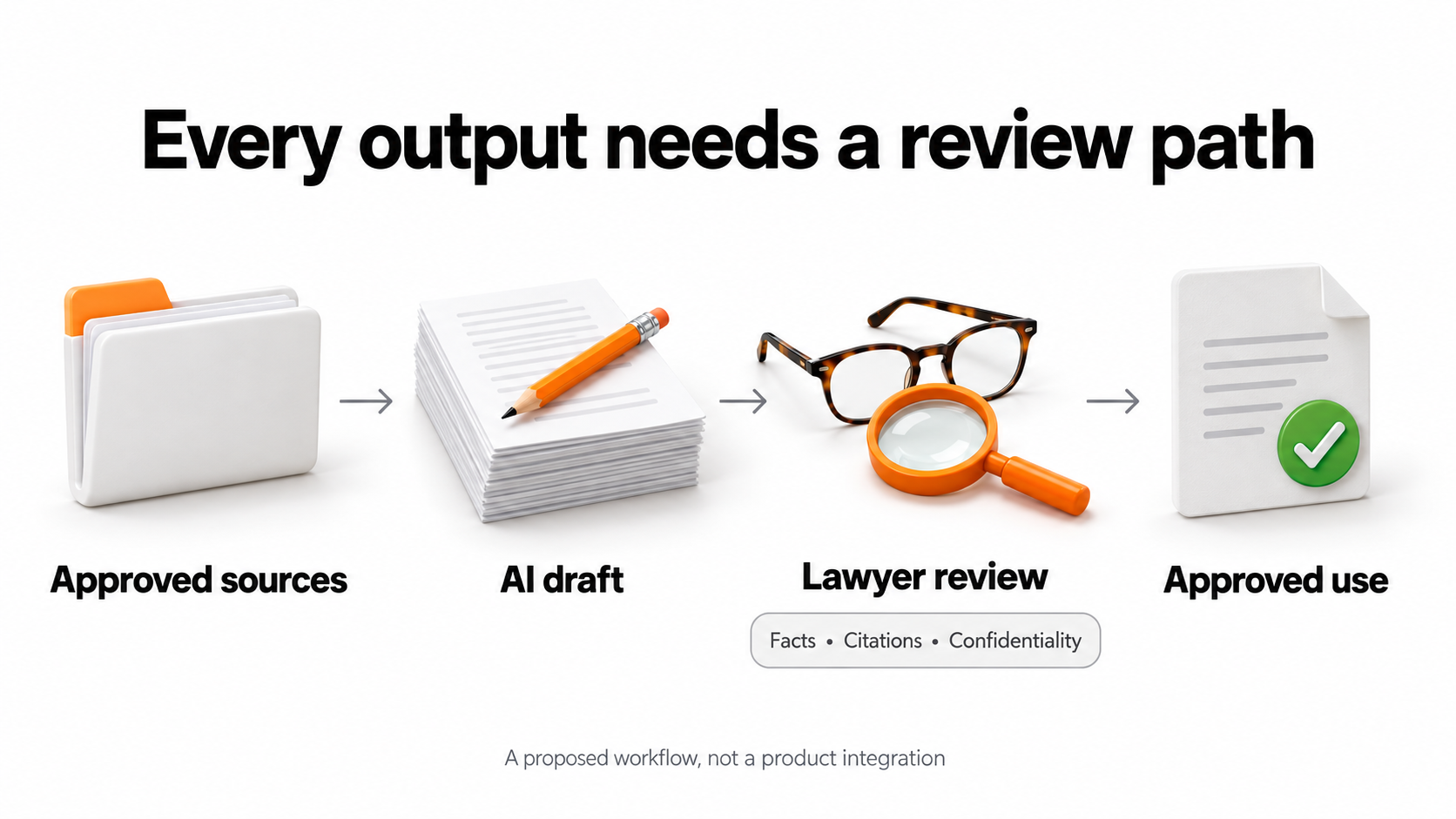
Make the review record part of the content. For each draft, store the version, source links, questions resolved, reviewer and approval date in the firm's approved workspace. When the writer revises a legal sentence after approval, return that sentence for review. An approval attached to last week's version should not silently authorize today's changes.
California's State Bar guidance on generative AI addresses competence, confidentiality and supervision, including the additional exposure created by agents with persistent access. It calls for evaluating and limiting that access, appropriate monitoring, and safeguards and human review for external transmission of client information. The guidance also discusses client communication and actual time spent for hourly billing. It is not an approval of any particular product.
Translate that into a concrete publishing boundary: the pilot receives public marketing material, creates a draft and stops. Your attorney evaluates the legal statements. Your publisher checks the contact details, links, image captions and approved wording. Access to the content management system is a separate decision from permission to read a folder.
Our recommendation is to keep a marketing pilot outside confidential matters until the firm has evaluated its actual contracts, settings, connected applications and client obligations. A statement about a model's capabilities is not evidence that every connected tool has the same retention policy or access controls.
Use permissions as an operating procedure
OpenAI's dot controls documentation explains action review and custom rules. It distinguishes asking for a draft from authorizing its delivery, and warns that instructions can be imperfect. Configure available permissions as well as writing clear instructions; do not rely on a sentence in a prompt as your only protection.
For this pilot, list approved sources, allowed changes, forbidden destinations and the person who can release work. Keep a separate exception queue for anything outside that list. If a source folder contains a client name, a settlement document or private intake notes, stop the content assignment and have the firm resolve the exposure before proceeding.
Also plan the stop procedure. Know who can revoke a connection, pause recurring work and inspect work already delegated. Maintain a brief incident record when a task accesses the wrong material or creates an unsupported claim. Record what happened, whether anything left the workspace and what control changed. This is a proposed firm procedure, not a claim that a product automatically provides every record described here.
Connect the content to the practice it supports
A reviewed article needs a useful next step. Link it to the relevant service page and a related explanation, using language that tells readers what they will find. For California firms, our AI marketing services page describes the marketing context, and our earlier Astra for Law analysis covers the launch and research limitations in more detail. Product availability should always be checked against current OpenAI documentation.
Before publication, check the title, description, one main heading, descriptive image text and canonical URL. Make sure the article's visible questions match its structured data. None of those steps proves the page will rank, appear in an AI answer or generate a retained case. They make the page easier to understand and reduce avoidable publishing errors.
For a local application, connect the topic to an actual service area such as our Los Angeles law firm marketing work. Geography should change the example or the service context. Replacing a city name without changing the substance adds little for the reader.
Judge the pilot by what the reviewer had to fix
Run a small, time-limited pilot chosen by your team. Compare a reviewed draft with the existing manual process. Track missing sources, incorrect statements, review time, revisions after approval and whether the proposed page answers a real client question. These are suggested measures, not performance claims about either product.
Keep business results separate. A published page, a form submission, a qualified consultation and a retained matter are different events. If the firm already tracks them, connect the approved article to that reporting without exposing confidential matter details to the content agent. Do not credit AI for a revenue change simply because the change occurred after the pilot began.
A firm operating in both states can compare this editorial approach with our sister site's Texas intake and AI workflow guide. California Law Firm SEO and Law Firm Marketing Texas are ByteZero brands. The companion article uses Texas-specific guidance and a different operational example.
Frequently Asked Questions
Can California law firms use OpenAI dots?
Eligible firms can consider dots for approved administrative or marketing tasks, subject to account availability and permissions. Start with public materials and a defined reviewer. A firm must separately evaluate any use involving confidential information.
Does a dot automatically include Astra for Law?
No automatic entitlement or integration is established by the documentation reviewed for this guide. Confirm access to Astra for Law separately, and use a supervised handoff between coordination and legal research.
What should a California firm try first?
A public-content review queue is a practical proposed starting point. Ask for unsupported claims, broken references and draft corrections using only approved sources. Have a lawyer review legal statements before an authorized publisher changes the site.
Can the workflow publish articles without lawyer review?
This proposed workflow requires lawyer review of legal statements and a separate publishing approval. A finished draft is not permission to publish, and changes after approval should return to the appropriate reviewer.
Does using Astra for Law improve Google rankings?
Using a legal research model does not itself establish a ranking benefit. Measure the accuracy and usefulness of published content separately from search traffic, inquiries and retained matters. Neither tool guarantees AI citations or leads.
Is this an attorney-reviewed implementation guide?
No. It is an educational proposal by a legal marketing team, grounded in the cited product documentation and California guidance. It is not legal advice, a completed deployment or a substitute for the responsible lawyer assessing the actual workflow.
About this guide: Prepared by the ByteZero SEO Team for California Law Firm SEO, a legal marketing brand. This is an educational workflow proposal, not legal advice, an attorney-reviewed legal opinion or an OpenAI partnership announcement. AI assisted with preparation and illustration. Firms should have their responsible lawyers assess proposed legal uses and confidentiality arrangements.