A legal answering service is an outside team, or a software receptionist, that picks up a law firm's calls when no one in the office can, takes the caller's details and passes them to the firm. For a California firm the service is acting for you on the phone. Its scripts, its recordings and how it handles what callers say all fall back on the firm, under the State Bar's rules and the Penal Code's recording law.
Demand for these services is real. Keyword Planner showed about 720 searches a month across the US for "legal answering service" when we pulled it on October 27, 2026, plus a few hundred more for "answering service for law firms" and "answering service for lawyers." When we checked the California results on November 11, 2026, nearly every page-one result was a vendor selling the service or a vendor's own list of the best ones. We are not an answering service, so this page skips the pitch and sticks to what we would ask any provider before a firm signs.
One week of call notes taught us more than any vendor demo
We run Local Services Ads for a California criminal defense firm. When we rate the leads Google charges for, we match each call to the firm's own lead tracker, a sheet where its intake person writes a resolution and a note for every caller. We only rate a lead when we find a tracker row logged within two minutes of the call.
Those notes show what the phone actually brings in. Some callers are crime victims who want to press charges or sue the police. Others need a civil restraining order, have a family court order problem or want help after a conviction. This firm does not take any of those. Then there are the callers the firm exists for: someone facing a hit-and-run or drug charge, or someone who expects to be charged and wants a lawyer before that happens. The person answering has to tell these apart in the first minute and send each one to the right place.
Those notes are also the only part of a call anyone can audit afterwards. You read them, your ad manager rates leads from them, and if a caller ever complains, your ethics counsel reads them too.
Free for California firms
Want these numbers for your own office?
We run the same map pack and AI visibility check for your practice and address in California, then show where you stand. No obligation.
Run my free audit →What a legal answering service does, and what it should not do
Most services offer some mix of the following. Ask for each one in writing:
- Live answering in the firm's name, during set hours or around the clock.
- Message taking with the caller's name, number, the type of matter and how urgent it is, sent by text or email.
- Scripted intake: a set of questions you write, so the firm can run a conflict check and decide whether to call back.
- Appointment booking straight into the firm's calendar.
- Spanish-speaking agents, which matter a great deal for many California practices.
What a service should not do is give legal advice, quote what a case is worth, or promise that a lawyer will take the matter. A receptionist who says "you definitely have a case" has made a statement on your behalf. Write the script so the agent collects facts, confirms the callback and stops there.
Setting up a service the California way
Many vendors say they can be live within days, and that speed is the risk: the greeting, the script and the recording setting can default to the vendor's generic settings. Before you forward a single call, do this:
- Decide whether calls will be recorded. California Penal Code section 632 makes it a crime to record a confidential communication without the consent of all parties (see the text of section 632), with fines of up to $2,500 per violation ($10,000 for a repeat offender) and possible jail time. The section covers calls made where a party reasonably expects the conversation to stay between the people on it, and a caller describing a legal problem to a law firm will usually expect exactly that. If the vendor records, the greeting has to tell every caller at the start.
- Write the intake script with conflicts first. Collect the names of the other parties before the caller tells the whole story, so the firm can run a conflict check. Our California legal intake guide walks through that order and the Rule 1.18 duties to prospective clients.
- Put confidentiality in the contract. Business and Professions Code section 6068(e)(1) requires a lawyer to keep client confidences, and Rule 1.18 extends that duty to what a prospective client says when they call about hiring the firm. Ask where call notes and recordings are stored, who at the vendor can read them and how long they are kept.
- Supervise the vendor. Rule 5.3 of the California Rules of Professional Conduct asks lawyers with managerial authority to make reasonable efforts to ensure that the nonlawyers they work with, outside vendors included, act in line with the lawyer's own duties. In practice: review the script, listen to a sample of calls each month and keep a record that you did.
- Test it as a caller would. Call the line after hours, from a mobile phone, in Spanish if you advertise in Spanish, and check how long the message takes to reach the lawyer.
The person who answers your phone at 11 p.m. is, to the caller, your firm. Script that minute as carefully as you would write your home page.
Paid leads make the after-hours call more expensive to miss
Here is the part people skip. Some firms add an answering service only after they start paying for calls, and then discover the two systems were never connected.
On October 20, 2026, Google's Local Services Ads support team told us in writing that it has no tool to credit charged leads by hand. Only Google's automated review can credit a lead, and only one it judges invalid. In our experience the one thing a firm can still feed that review is an accurate rating of each lead. A firm that pays per call, cannot see what was said and leaves leads unrated has given up the one lever it has. Our guide to PPC for California law firms covers how Google Search ads, Local Services Ads and Meta ads bill a law firm.
So when you choose a service, ask whether its notes can be exported into the sheet or CRM your ad manager rates leads from, and how fast. A message that sits in an agent's inbox until morning cannot be matched to a charged call. If the firm pays per call, the answering service is part of the ad budget, not just the front desk.
AI search check
Is ChatGPT recommending your firm in California?
Our free scan checks how ChatGPT, Gemini and Google AI Overviews describe your firm and which competitors they name instead.
Check my AI visibility →Live receptionists, AI receptionists and hybrids
When firms compare services, three questions come up again and again, and all three turn on the same thing: will the notes be good enough to act on?
Is an AI receptionist good enough for a law firm?
For booking, hours and simple routing it can be. For a frightened caller describing an arrest or an injury, a human usually does better. Many firms let software answer first and hand off to a person when the caller wants one.
Should the service answer 24 hours a day?
It depends on the practice. Criminal defense and injury calls can come at night and on weekends, right after something happened. An estate planning firm can usually let calls go to a message and return them the next business day.
Do we need Spanish-speaking agents?
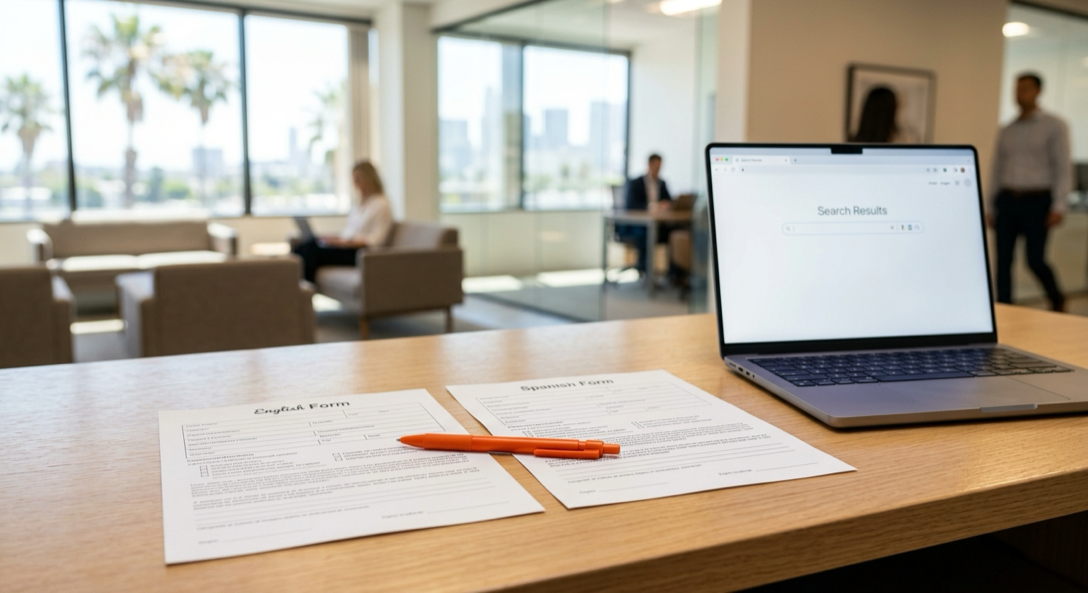
If the firm advertises in Spanish or practices in a county where many clients speak it, yes. A Spanish ad that reaches an English-only operator wastes the click and can leave the caller with a poor impression of the firm.
What the firm said when we sorted calls by value
Call notes also showed us which callers the firm wanted more of. On October 22, 2026, the defense firm's lead attorney told us the firm prefers new cases to old-warrant cases. The firm still takes those matters, so we stopped rating warrant calls as booked clients, to avoid teaching the ad platform that those are the calls the firm wants most.
That kind of preference only shows up when the person answering writes down what the call was about, in words the firm can sort later: "new DUI arrest, court date in two weeks" is useful; "potential client, call back" is not. Give the service a short list of matter types and ask its agents to pick one on every call. Notes that specific are what let a firm steer its ads toward the cases it actually wants.
How to compare legal answering services

Vendors price by the minute, by the call or by a monthly plan, so compare what you get rather than the headline rate. We would put these questions to every service on a shortlist:
| Question | Why it matters for a California firm |
|---|---|
| Do you record calls, and what does the greeting say? | Penal Code 632 requires consent from all parties to a confidential call |
| Where are notes and recordings stored, and for how long? | Client confidences under B&P Code 6068(e)(1) |
| Can we write and change the intake script ourselves? | Conflict check first, no legal advice, Rule 1.18 duties |
| How fast do notes reach us, and in what format? | Matching notes to paid calls before rating them |
| Are Spanish-speaking agents available on every shift? | Spanish ads and Spanish-speaking clients |
| Can we listen to a sample of our calls each month? | Rule 5.3 supervision of nonlawyer vendors |
If a service is vague on the first two, keep looking. Recording and storage are where a cheap plan can cost a firm far more than it saves, because both touch client confidences directly.
Common questions from California
What is a legal answering service?
It is a team or software that answers a law firm's calls when staff cannot, takes the caller's details and sends them to the firm. Some also run a scripted intake or book consultations.
Can an answering service record calls in California?
Only with the consent of everyone on the call. Penal Code section 632 bars recording a confidential communication without all-party consent, so the greeting should say the call may be recorded.
Is a legal intake answering service different from a regular one?
Yes. A regular service takes a message. An intake service follows the firm's script, asks screening questions and may book a consultation, so the firm has to review that script closely.
Who is responsible if the answering service gives bad information?
The firm carries the risk. Rule 5.3 asks lawyers with managerial authority to make reasonable efforts to make sure outside vendors act in line with the lawyer's own duties, so review the script and sample calls. A lawyer can be held responsible for a vendor's conduct the lawyer directed or approved, or knew about and failed to fix.
How do we know if the service is working?
Compare the calls it logged with the calls your phone carrier and ad platforms show, check how fast notes arrive, and track how many logged callers became consultations and signed matters.
What to do this week
Pull the last month of calls from your phone system and count how many arrived outside office hours or went to voicemail. Call your own number tonight as a client would. If the call goes unanswered, or a service answers but leaves notes you could not act on, fix the script before you spend more on ads. If you would like a second set of eyes on how calls, ads and intake connect, that is part of the work we do through our California law firm marketing service.
None of this is legal advice. Before any script goes live, have the firm's ethics counsel read it along with the vendor contract.