
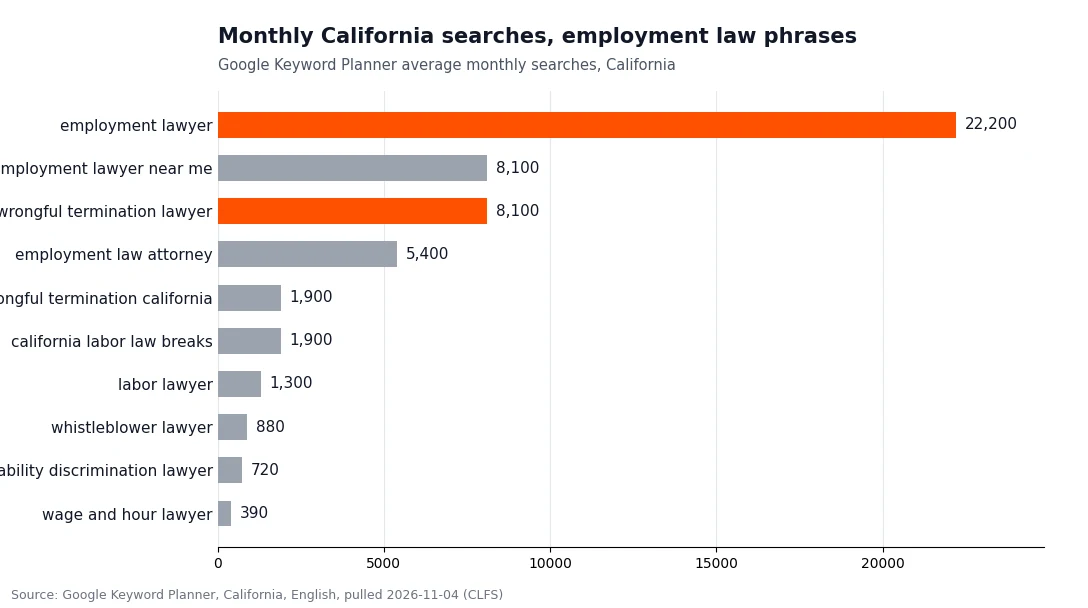
Over twelve months, a California employer-defense site we manage took 4,936 sessions from paid search and 178 from organic search. For that practice, employment lawyer SEO is the unbuilt half: the ads carry the intake and the organic channel sits almost empty. The demand is there. "Employment lawyer" averaged 22,200 California searches a month in Google Keyword Planner on November 4, 2026, and "wrongful termination lawyer" another 8,100.
Employment is also two markets with different searches. Employee-side firms compete for tens of thousands of monthly searches. Employer-side firms work with a few hundred. We pulled both sets, checked who ranks for "employment lawyer" in four California cities, and set the numbers next to our own client data.
22,200 searches on one side, a few hundred on the other
Employee-side demand is large and the organic results are crowded with directories; employer-side demand is small enough that a handful of precise pages can cover most of it.
- "Employment lawyer" averaged 22,200 California searches a month; the employer-side phrases we checked each averaged 210 or fewer.
- Super Lawyers held an organic top-10 spot for "employment lawyer" in three of the four cities we checked. Justia appeared in none of them.
- Firm websites ranking on page one for employment searches had a median Ahrefs Domain Rating of 22, the second highest of six practices.
- In our map pack study, the median employment 3-pack firm had about 88 Google reviews across six cities.
- Our employer-defense client's site converted paid search visits at 7.3 percent and organic visits at 2.8 percent.
Free for California firms
Want these numbers for your own office?
We run the same map pack and AI visibility check for your practice and address in California, then show where you stand. No obligation.
Run my free audit →Employee-side and employer-side keywords
| Phrase (California) | Side | Monthly searches | Top-of-page bid range |
|---|---|---|---|
| employment lawyer | Mostly employee | 22,200 | $23 to $86 |
| wrongful termination lawyer | Employee | 8,100 | $31 to $112 |
| employment lawyer near me | Mostly employee | 8,100 | $19 to $77 |
| california meal break law | Employee, informational | 1,900 | $0.03 to $6 |
| paga lawsuit | Both | 1,000 | $3 to $25 |
| whistleblower lawyer | Employee | 880 | $13 to $51 |
| wage and hour lawyer | Employee | 390 | $16 to $121 |
| employment lawyer for employers | Employer | 210 | $19 to $61 |
| employer defense attorney | Employer | 110 | $13 to $43 |
| labor law attorney for employers | Employer | 70 | $19 to $57 |
| paga defense attorney | Employer | 30 | no bid data |
Put the biggest phrase on each side next to each other: 22,200 monthly searches for "employment lawyer" against 210 for "employment lawyer for employers", a ratio of more than 100 to 1 in this one snapshot. Keyword Planner rounds volumes and they move month to month, but no reasonable error closes a gap that size. An employee-side firm in Los Angeles is chasing a statewide pool of more than 22,000 monthly searches for one phrase. An employer-side firm is working with a few hundred searches a month for all its main phrases combined, so its site has to win a larger share of a much smaller pool.
Informational phrases cross both sides. "California meal break law" averaged 1,900 searches a month and "paga lawsuit" 1,000, with low bids ($6 and $25 at the high end). Employees use these searches to check their rights; HR managers use them to check exposure. A well-sourced explainer can draw both, and on an employer-side site it is often the page that brings a business owner in for the first time.
Who ranks for "employment lawyer" in California
We looked up the organic top 10 for "employment lawyer" plus Los Angeles, San Diego, San Francisco and Sacramento in Ahrefs on November 4, 2026 (Ahrefs' crawls were dated October where shown). Super Lawyers held a spot in Los Angeles at position 9, San Diego at 7 and Sacramento at 5. Justia, which appeared in most of the other practice searches we checked, did not show up for employment in any of the four cities. The Los Angeles Times had a ranked list of employment firms at position 8 in Los Angeles, and Reddit threads asking for recommendations ranked in San Diego and Sacramento.
Firm websites that ranked were stronger than in most practices. Their median Ahrefs Domain Rating was 22, against 4 for estate planning and 26 for personal injury. In practical terms, employment firms that rank on page one have stronger link profiles than most practices, and a new page on a young site will take longer to break in. Large firms also take spots with a city page on a national site: a Sacramento labor and employment page from a national plaintiff firm and a Sacramento office page from a national employer-side firm both made the Sacramento top 10.
Employment map packs: 88 reviews in the typical slot
Local results are a different story. In our California law firm map pack study, the median employment firm in a Google 3-pack had about 88 reviews across six cities, close to the lowest of the six practices. In San Jose and Sacramento a firm with fewer than ten reviews held an employment pack slot. Los Angeles was the exception, with an employment pack median of 279, and San Francisco was the cheapest at 38.
When the review bar is that low, the profile details decide most of the order: the primary category (91 of the 120 employment listings in our study used "Employment attorney"), a full list of services in the words clients use, and a link to a page about the office. For an employee-side firm outside Los Angeles, the map pack is where the review bar is lowest.
AI search check
Is ChatGPT recommending your firm in California?
Our free scan checks how ChatGPT, Gemini and Google AI Overviews describe your firm and which competitors they name instead.
Check my AI visibility →Our own data: what an unbuilt organic channel looks like
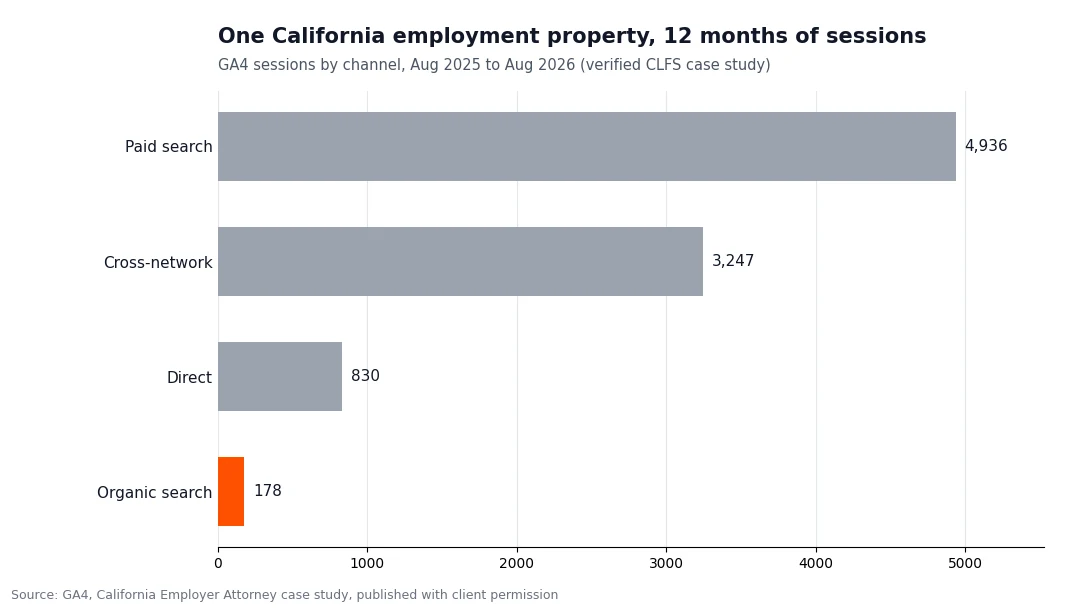
The site in the opening line is the conversion property for a California employer-defense practice whose paid search we run. Over the twelve months to August 2026 it took 9,260 sessions and 476 conversions. Paid search brought 4,936 of those sessions at a 7.3 percent conversion rate. Organic search brought 178 sessions at 2.8 percent. In Search Console the site earned 3,102 impressions and 37 clicks across its top pages, at average positions between 22 and 54. The full numbers are in our California Employer Attorney case study.
We publish the weak half on purpose. The site was built to receive paid clicks, and it does that well. Its organic channel is the next piece of work, and the keyword table above is why we expect it to be a slow build: the employer-side phrases it needs average a few hundred searches a month combined, so each page has to match its query closely to earn the click at all.
Paid search brought 4,936 sessions to this site in a year. Organic brought 178.
Claim pages, employer pages and the questions in between
For employee-side firms, start with one page per claim type the firm takes: wrongful termination, discrimination, harassment, retaliation, whistleblower and wage and hour. Each should say which California statute the claim usually rests on, what a client should keep (emails, pay stubs, schedules), and who at the firm handles it. The Civil Rights Department's own summary is a good source to cite for discrimination pages: it says the Fair Employment and Housing Act applies to employers of five or more employees and covers retaliation for asserting rights (California Civil Rights Department).
For employer-side firms, build fewer pages and make each one narrower: PAGA defense, wage and hour class action defense, handbook and policy reviews, and an explainer on California meal and rest break rules written for HR managers. Add a page about the industries the firm defends most, because a restaurant group and a staffing agency search for different problems.
Whichever side the firm is on, the intake pages carry the questions clients bring. Google's People Also Ask box for this topic included the odds of winning an employment lawsuit; a claim page can explain what evidence tends to matter without predicting the odds for any one case. Another question in the same box, what not to tell the attorney, is a good reason for a short page on how attorney-client privilege covers a consultation. Office pages should match each Google Business Profile, and attorney bios should carry State Bar numbers. Our AI SEO service for California law firms starts from the Search Console queries a site already draws, so the first pages written are the ones with impressions behind them.
California's advertising rules on employment pages
Employment pages invite headline settlement figures. California Rule of Professional Conduct 7.1 treats a guarantee of a result as misleading, and its comment warns that a truthful report of past results can mislead if it suggests the same outcome is likely for other clients without reference to each case's facts (State Bar of California, Rules of Professional Conduct, chapter 7). Put the context and a disclaimer next to any figure.
The same comment covers language claims. A communication may not state or imply that the lawyer can provide legal services in another language unless the lawyer actually can, or the communication states, in that language, the employment title of the person who speaks it. For employee-side firms in Los Angeles, the Central Valley or San Diego, a Spanish version of each claim page is often worth building, and it has to be accurate on that point.
Ninety days of employment lawyer SEO, in order
Profiles and office pages come first, because they are the quickest work on the list, with one profile and one office page for each staffed office. Outside Los Angeles, employment pack review bars in our study were low enough that profile work can move a firm.
The claim-type pages follow in month two, in order of search volume for your side: wrongful termination first for employee-side firms, and a page for "employment lawyer for employers" (210 a month) first for employer-side firms. Add FAQ entries drawn from the informational phrases.
By month three there is Search Console data to read, and pages sitting at positions 8 to 20 for a phrase with real volume get rewritten first. Paid search keeps running throughout; for the employer-side practice in our case study, the ads carried the intake while the organic pages were built, a trade-off our SEO vs PPC comparison for California law firms covers in detail.
If you're comparing quotes
How many people search for an employment lawyer in California?
"Employment lawyer" averaged 22,200 California searches a month in Google Keyword Planner as of November 2026, with another 8,100 for "employment lawyer near me" and 8,100 for "wrongful termination lawyer".
Is SEO worth it for employer-side employment firms?
It works on a smaller scale. The employer-side phrases we checked each averaged 210 California searches a month or fewer, so a small set of precise pages can cover most of the demand. For the employer-side client in our case study, paid search carried most of the intake.
How many Google reviews does an employment firm need for the map pack?
In our six-city map pack study, the median employment 3-pack firm had about 88 reviews. Los Angeles was higher at 279, and in San Jose and Sacramento a firm with fewer than ten reviews held a pack slot.
Which directories rank for employment lawyer searches in California?
Super Lawyers held an organic top-10 spot in three of the four cities we checked. Justia did not appear for employment in any of them, although it appeared in most other practices.
What does employment lawyer SEO cost compared with Google Ads?
Keyword Planner's top-of-page bid range for "employment lawyer" in California was $23 to $86 a click, and $31 to $112 for "wrongful termination lawyer". Organic traffic has no per-click charge; the cost is the writing and page work.
Can an employment law page list settlement amounts?
Past results can be reported truthfully, but California Rule 7.1's comment warns they can mislead without context. Pair any figure with the facts that drove it and a statement that results depend on each case.