In our California law firm map pack study, the median firm in a 3-pack had 160 Google reviews. That number comes from 36 searches we ran on November 4, 2026: six practice areas in six cities, Los Angeles, San Diego, San Francisco, San Jose, Irvine and Sacramento. It is lower than most partners guess, and it hides a spread wide enough to change where a firm should spend its next marketing dollar. Three Los Angeles personal injury firms held the pack with 1,300, 2,000 and 2,500 reviews. A Sacramento employment firm held a spot with five.
This is the study we wanted to read and could not find. It covers what the pack looks like by city and by practice, where the review bar is low enough to clear in a year, and where reviews stop being the deciding factor.
What the six-city data shows
The headline number is lower than most partners expect, and the spread underneath it is what should drive a budget.
- Across 110 map pack slots, the median firm had 160 Google reviews and a 4.9 rating. 36 of the 110 slots went to firms with fewer than 100 reviews.
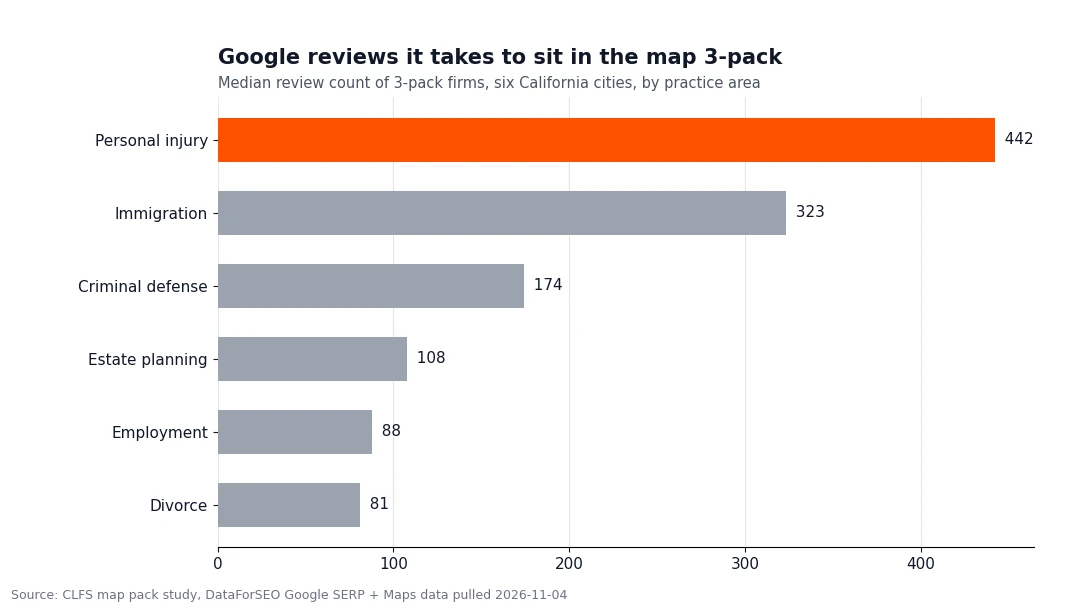
- Personal injury is the expensive pack: a median of about 440 reviews per firm across the six cities. Divorce and employment sit near 80 to 90.
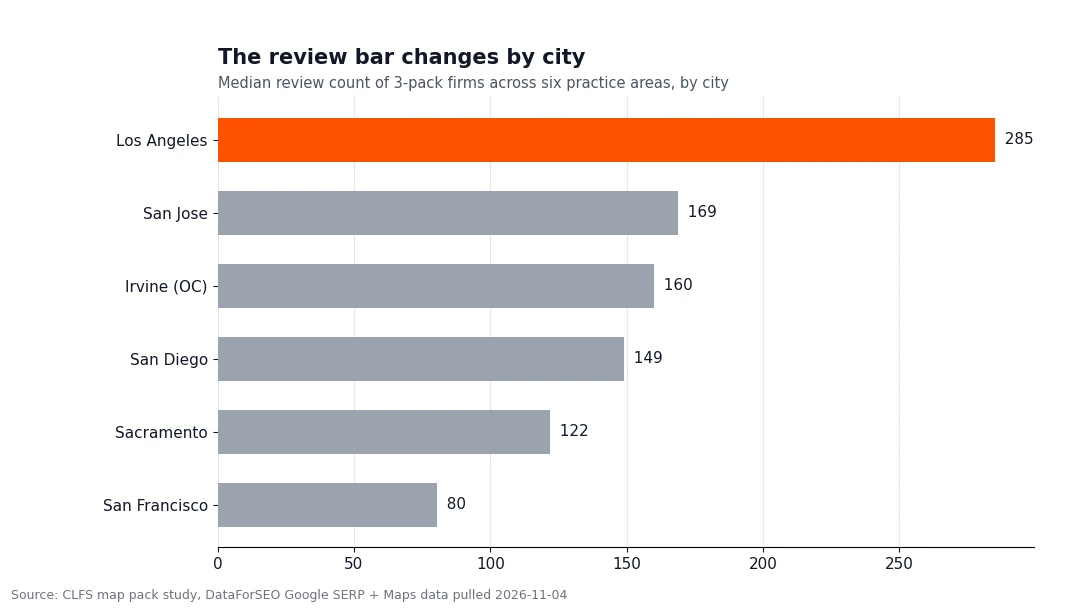
- Los Angeles has the highest bar (median 285 reviews). San Francisco has the lowest of the six cities (median about 80).
- In Google Maps itself, the top 3 Los Angeles personal injury results had fewer reviews (median 133) than positions 4 to 20 (median 181). Past a threshold, relevance and distance decide the order.
- Google showed an AI Overview on 9 of the 36 results pages, so the pack is no longer the only feature a searcher sees.
Free for California firms
Want these numbers for your own office?
We run the same map pack and AI visibility check for your practice and address in California, then show where you stand. No obligation.
Run my free audit →How we ran the map pack study
We used the DataForSEO SERP API to run two searches for each city and practice pair, with the search location set to the city. The first was a normal Google web search for the practice plus the city name, for example "divorce lawyer san diego". From that page we recorded the local 3-pack: the firm, its star rating and its review count. The second was a Google Maps search for the practice alone, for example "divorce lawyer", where we recorded the top 20 results.
The six practices were personal injury, criminal defense, divorce, immigration, employment and estate planning. Irvine stands in for Orange County. Two searches returned a four-firm pack, so the total is 110 firm slots, not 108. Every search ran on November 4, 2026 through DataForSEO's live SERP API, in English, as a desktop search with no signed-in Google account. We picked these six practices because they are consumer-facing work where clients find a firm through local search.
One snapshot from one point in each city is a sample. A searcher two miles away, or on a different day, can see a different pack. Read the numbers as the order of magnitude a firm is competing against, not a guaranteed target. The raw data and the scripts that produced it are kept with the study so we can rerun it each quarter and show the change.
What a California map pack looks like in 2026
The rating floor is high and flat. The median pack firm had a 4.9 rating, 90 percent of the slots went to firms at 4.8 or higher, and the lowest rating in any pack was 4.2. A firm sitting at 4.3 in a competitive practice has a rating problem before it has an SEO problem.
Review counts are where the cities and practices pull apart. The median was 160, the smallest was 5 and the largest was 3,400 (a Sacramento personal injury firm). 13 of the 110 slots went to firms with fewer than 50 reviews. Six of those 13 slots are in San Francisco, and most of the rest are in employment, divorce or estate planning packs.
Reviews get a firm into the pool. Category, services, office address and on-page relevance decide its place inside the pool.
The review bar by practice area
| Practice | Median reviews in the 3-pack | Fewest reviews in any pack |
|---|---|---|
| Personal injury | about 440 | 116 |
| Immigration | 323 | 108 |
| Criminal defense | about 174 | 41 |
| Estate planning | about 109 | 24 |
| Employment | about 88 | 5 |
| Divorce | 81 | 31 |
Immigration surprised us. Its median of 323 is second only to personal injury, and its lowest pack firm still had 108 reviews. The firms holding these packs have built large review bases, and a new immigration practice should plan on a long review program or a narrower geography.
Employment and divorce are the opposite. In all six cities a firm with under 100 reviews held a divorce pack slot, and in San Jose and Sacramento an employment firm with under ten reviews held one. When the bar is that low, the firms that win are usually the ones whose Google Business Profile category, services and website pages match the search most precisely. We cover that work in our guide to Google reviews and law firm SEO.
AI search check
Is ChatGPT recommending your firm in California?
Our free scan checks how ChatGPT, Gemini and Google AI Overviews describe your firm and which competitors they name instead.
Check my AI visibility →The review bar by city
| City | Median reviews in the 3-pack | Fewest reviews in any pack |
|---|---|---|
| Los Angeles | 285 | 34 |
| San Jose | 169 | 7 |
| Irvine (Orange County) | 160 | 41 |
| San Diego | 149 | 45 |
| Sacramento | 122 | 5 |
| San Francisco | about 80 | 24 |
Los Angeles is the hardest pack in the state by a wide margin, and personal injury drags it up: the three firms in that pack averaged close to 1,900 reviews. Take personal injury out and Los Angeles still leads, because its immigration pack (median 595) and employment pack (median 279) are also the highest of the six cities.
San Francisco is the cheapest pack to enter on reviews. Its criminal defense pack had a median of 44 and its employment pack a median of 38. When the review counts are this close, distance to the searcher carries more of the weight, so the office address matters as much as the review count. San Jose looks similar except in criminal defense, where all three pack firms had more than 230 reviews.
Where reviews stop deciding the order
Google says local results are based on relevance, distance and popularity, and that reviews feed into popularity (Google Business Profile Help). Our Maps data shows what that means in practice. In Los Angeles, the top three Maps results for "personal injury lawyer" had a median of 133 reviews. Positions 4 to 20 had a median of 181. Several firms with more reviews sat below firms with fewer, because they were farther from the search point or their profiles matched the search less closely.
The same pattern shows up in Los Angeles estate planning and Irvine estate planning, where the Maps top 3 had fewer reviews than the rest of the top 20. In personal injury, immigration and criminal defense the top 3 usually did have more. The practical reading: reviews get a firm into the pool, and the category, service list, office address and on-page relevance decide its place inside the pool.
What this means for a California firm's next 12 months
Start with the gap, not the goal. Take your current review count for your main practice and city, compare it to the fewest-reviews number in the tables above, and work out the monthly pace that closes the gap. A Sacramento divorce firm with 30 reviews needs about 50 more to reach the weakest current pack firm. A Los Angeles personal injury firm with 300 reviews is still 1,000 short, and its money is probably better spent on neighborhood pages and a second office location than on chasing the pack head-on.
Ask for reviews the right way. Google's policy forbids offering anything of value in exchange for a review (Google Maps user-contributed content policy), and the FTC's rule on consumer reviews bans fake reviews and paying for positive or negative ones (16 CFR Part 465). A steady ask at matter close, sent by the attorney who handled it, is slower and safer. California attorneys also have Rule 7.1 to think about when reviews are reused in advertising (State Bar of California, Rule 7.1).
Fix relevance before volume. Primary category, secondary categories, the services list, the practice-area page the profile links to and the office address shown on that page should all say the same thing. In the low-bar packs (employment, divorce, estate planning, most of the Bay Area) that alignment is often enough to move a firm with 40 reviews past one with 90.
Watch the AI Overview. Google showed an AI Overview on 9 of our 36 searches, four of them in San Jose and two in San Francisco. We recorded whether an overview appeared, not what it said, so we cannot say which firms it named. It does mean that on about one search in four, the map pack shares the results page with an AI summary.
City-by-city deep dives
We are publishing a separate breakdown for each city in the study, with the practice-level tables, the Maps top 3 against the rest, and the neighborhoods where the bar is lower. Each city page on this site links to its own breakdown as it goes live. If you want the numbers for your exact practice and office address, our team can rerun the study for your firm.
Things people ask before booking
How many Google reviews does a law firm need to get into the map pack in California?
In our November 2026 sample of six cities, the median firm in a 3-pack had 160 reviews, and 36 of 110 slots went to firms with fewer than 100. The number depends heavily on practice and city: about 440 for personal injury, close to 80 for divorce, and much lower in parts of San Francisco, San Jose and Sacramento.
Which California city has the most competitive map pack for lawyers?
Los Angeles, with a median of 285 reviews per pack firm across six practices. Its personal injury pack had firms with 1,300 to 2,500 reviews, and its immigration and employment packs were also the highest of the six cities we checked.
Do more reviews always mean a higher map ranking?
No. Google ranks local results on relevance, distance and popularity. In our Los Angeles personal injury Maps results, the top three had fewer reviews than positions 4 to 20. Reviews help a firm qualify, and profile relevance and distance to the searcher decide much of the order after that.
What star rating do law firms in the map pack have?
The median was 4.9, 90 percent of the pack slots went to firms rated 4.8 or higher, and the lowest rating in any pack was 4.2.
Can a law firm pay for Google reviews or offer something in return?
No. Google's content policy prohibits incentives in exchange for reviews, and the FTC's consumer review rule, 16 CFR Part 465, prohibits fake reviews and paying for positive or negative reviews. Ask clients directly at the end of a matter and do not offer anything in exchange.
How often does Google show an AI Overview on local lawyer searches?
On 9 of our 36 searches, about one in four. It appeared most often in San Jose (four searches) and San Francisco (two).