Content Strategy Is Now Law Firm Survival Strategy
In 2026, your law firm's content does double duty: it ranks in Google's classic results and it feeds the AI engines — ChatGPT, Perplexity, Gemini, Google AI Overviews — that answer legal questions before a client ever clicks a link. A legal content strategy that ignores either channel forfeits cases to firms that cover both. This is the framework we use to build content programs for California law firms.
The Four Content Layers Every California Law Firm Needs
1. Practice Area Pillar Pages
One authoritative page per practice area — 2,000+ words, California-specific statutes and deadlines, real case results, attorney credentials, and Service schema. These pages anchor your rankings for head terms like "Los Angeles employment lawyer" and act as the hub every supporting page links back to. We break down the practice-area playbook in Practice Area SEO for California law firms.
2. Local Landing Pages
Practice area × city pages capture the high-intent searches: "dui attorney bakersfield," "divorce lawyer san jose." Thin, templated city pages get ignored; pages with genuine local content — courts, filing procedures, local case results — rank and convert.
3. Question Content (the AI layer)
Every legal matter starts with questions: "how much does a DUI cost in California," "what is my personal injury case worth." These queries now trigger AI-generated answers 65% of the time. Publishing precise, well-structured answers with FAQPage schema is how your firm gets cited as the source. This is the heart of generative engine optimization (GEO).
4. Trust Content
Case results, client stories, attorney bios with bar numbers and publications. Google's E-E-A-T guidelines treat legal content as "Your Money or Your Life" — author credentials aren't decoration, they're a ranking factor.
The Publishing Cadence That Actually Works
Volume without strategy is noise. For most California firms we recommend: 4 question-focused articles per month, 1 pillar page built or rebuilt per quarter, and location pages rolled out in priority-city order based on search demand. Every piece gets internal links to its pillar, schema markup, and a conversion path.
AI-Assisted, Attorney-Reviewed
AI drafting tools have collapsed the cost of producing legal content — and flooded Google with identical generic articles. The differentiator in 2026 is what AI can't fake: real case outcomes, actual California court experience, and attorney review of every claim. Our pipeline pairs AI research and drafting speed with human legal review, which is why client content earns citations instead of spam demotions. Learn more about our legal content strategy service.
Measuring What Matters
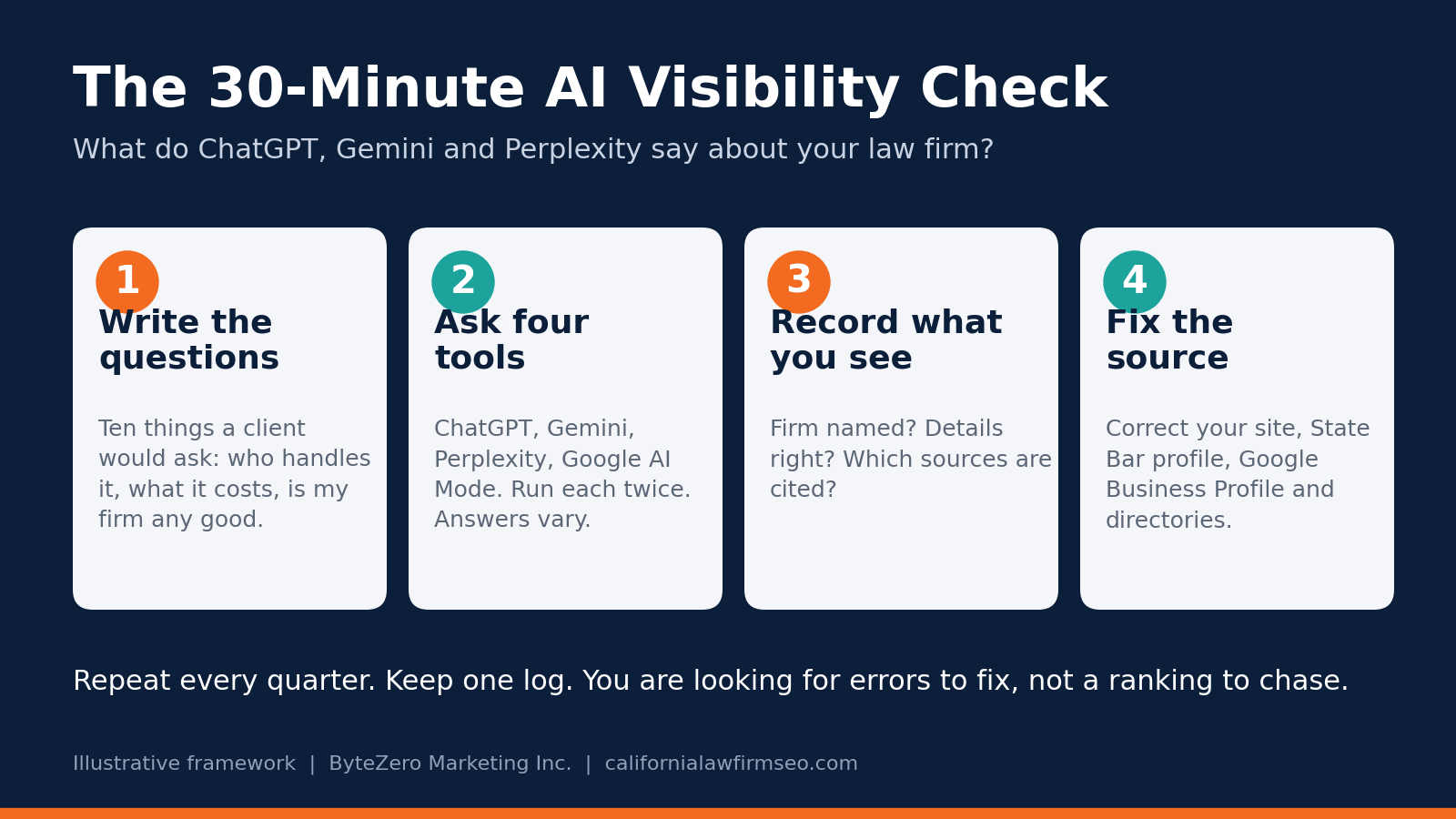
Traffic is a vanity metric if it doesn't sign cases. We track: qualified consultations by content source, rankings for money keywords by practice area, AI citation share (how often ChatGPT, Perplexity, and Google AI Overviews cite the firm), and cost per signed case versus paid channels — a comparison we detail in Google Ads vs SEO.
Get a free AI visibility audit to see exactly which content gaps are costing your firm cases right now.