Key Takeaways
- The unit of competition changed. A Google ranking is a position your page occupies. An AI citation is a sentence a model extracts, attributes and drops into an answer. Optimising a page for something that quotes sentences is a category error.
- There are two doors into an AI answer, not one. A model's trained memory and its live retrieval layer behave completely differently, reward completely different work, and operate on completely different timelines. Most advice conflates them.
- Liftability is testable. A quotable sentence is standalone, specific, attributable and checkable. Run any four sentences of your practice-area copy against those and the result is usually uncomfortable.
- No model stakes an answer on one source. Corroboration elsewhere on the web decides whether your claim is safe to repeat — which means some of this work does not happen on your website at all.
- California's advertising rules are an advantage here. The copy CRPC 7.1–7.5 permits — specific, substantiated, free of unverifiable superlatives — is precisely the copy a machine can lift. Vague marketing language is both the higher legal risk and the unliftable one.
The Unit Changed and the Playbook Didn't
Twenty years of search optimisation trained everyone to think in pages. You built a page, you pointed links at it, it occupied a position, and the position produced traffic. Position was the currency. Everything — keyword targeting, internal linking, title tags — served the goal of moving one page up a list.
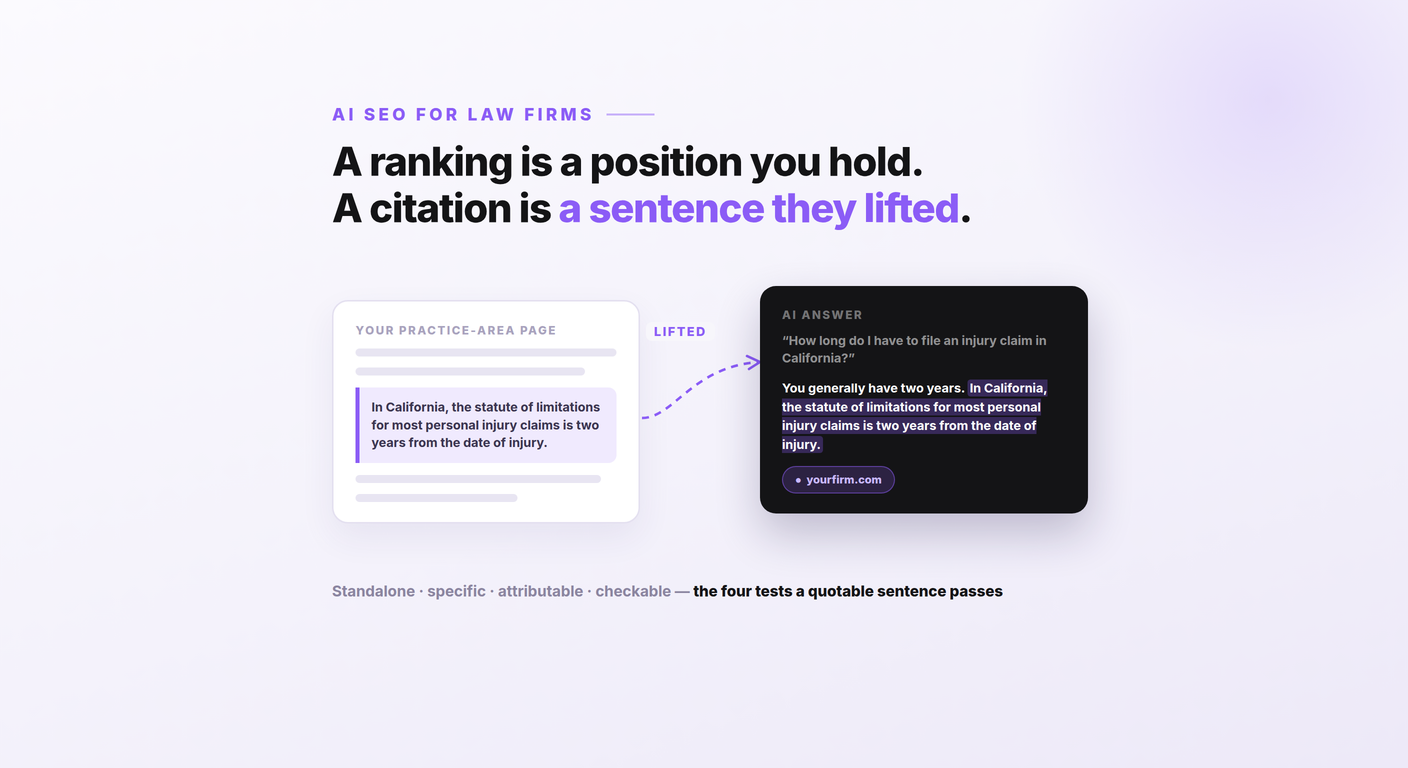
An AI answer does not have a list. It has a paragraph, and somewhere in that paragraph is a claim with a small superscript number or a source chip beside it. That claim came from a specific sentence on a specific page, and the model chose it not because the page ranked but because the sentence was usable.
This is a genuinely different game and most law firm content is still playing the old one. A 2,000-word practice-area page can rank respectably and contain not a single sentence a model would ever quote, because every sentence in it depends on the sentence before it, hedges its only specific claim, or says something no more precise than "our attorneys fight aggressively for our clients."
The shift is from writing pages that rank to writing sentences that survive extraction. Those are related skills, but they are not the same skill, and the second one is barely taught.
Two Doors, Not One
Almost every guide to AI search treats "getting into AI answers" as a single objective. In practice there are two separate mechanisms and they reward different work.
The first door is trained memory. A model absorbs an enormous corpus during training and carries a compressed impression of it. If it "knows" a firm without looking anything up, that knowledge came from the corpus — and it arrived slowly, from many corroborating sources, long before anyone asked. You cannot optimise directly into this door. You can only become the kind of entity the web repeatedly describes the same way, and then wait.
The second door is live retrieval. When a system fetches current pages to ground its answer, everything changes: the timeline collapses from years to days, and the deciding factors become mechanical — can the page be crawled, is the relevant claim easy to locate on it, is it structured clearly enough to attribute. This door is engineering, and it is the one a firm can actually work on this quarter.
Confusing the two is why so much AI SEO advice feels unfalsifiable. "Build authority so AI knows who you are" is advice about the first door, delivered on the timeline of the second. Both matter. Only one of them responds to what you publish next week — and that one is mostly a structure problem, which is why we treat AI SEO for California law firms as an engineering discipline rather than a writing genre.
The Liftability Test
Here is the practical core. For a sentence to be quotable by a machine, it has to pass four tests at once. Miss one and it is effectively invisible to an answer engine, no matter how well the page ranks.
1. Standalone. The sentence must survive being torn out of its paragraph. If it begins "This means that…" or "As discussed above…", it dies on extraction, because the model is lifting one sentence and the context is not coming with it.
2. Specific. It must contain something concrete — a number, a deadline, a statute, a named jurisdiction, a defined term. "California has a strict deadline for personal injury claims" is unusable. "In California, the statute of limitations for most personal injury claims is two years from the date of injury" is a sentence a machine can carry into an answer.
3. Attributable. The model must be able to say who is making the claim. This is where structured data earns its keep: schema tells a parser that this page belongs to this named legal service, written by this named person, about this jurisdiction. Attribution is not decoration; it is the difference between a quotable claim and an anonymous string.
4. Checkable. The claim must be the kind of thing that could be verified — and, ideally, is verified elsewhere. Models are conservative about repeating claims nothing else supports, which brings us to the part almost nobody mentions.
Nothing Gets Quoted On Its Own Say-So
An answer engine is, functionally, a nervous editor. It will not stake a factual claim on a single unsupported source, because the cost of being wrong is high and the cost of choosing a better-corroborated source is zero.
The practical consequence for a law firm is uncomfortable: some of the most important AI SEO work does not happen on your website. Whether your firm's name, address, practice areas and attorney credentials are described identically across bar directories, legal indexes, review platforms and your own site is not a housekeeping task — it is the corroboration layer that decides whether a model treats your claims as safe to repeat.
Firms tend to underinvest here because it feels clerical. It is the opposite. Consistency across independent sources is the closest thing to a ranking signal the first door has, and it is the one thing a competitor cannot copy quickly.
Your Compliance Constraints Are a Competitive Advantage
Now the part that should genuinely change how a California firm writes.
Attorney advertising in this state is governed by Rules of Professional Conduct 7.1–7.5, and since SB 37 took effect the definition of an advertisement reaches your website and landing pages too — we covered the mechanics in our breakdown of what SB 37 now requires. The rules push you away from unverifiable superlatives and toward substantiated, specific statements.
Read that list again next to the liftability test. They are the same list. "The best criminal defense attorney in Los Angeles" is simultaneously a compliance problem and an unquotable sentence — a model has no way to verify it and no reason to repeat it. "Handled 341 criminal matters in Los Angeles County since 2012" is compliant, specific, checkable, and exactly the shape of claim an answer engine will lift.
Most industries have to choose between marketing copy and machine-readable copy. California lawyers do not. The regulator has already pushed you toward the writing that works.
What To Measure When the Click Never Arrives
There is an obvious objection to all of this: if the AI answers the question, the person never visits your site. Sometimes that is exactly what happens, and it breaks the only measurement most firms have.
Sessions and rankings both assume the visit is the outcome. In an answer-engine world, a substantial amount of value shows up as being named to someone who never clicks — and then calls, or searches your firm by name later, or arrives weeks afterwards through a channel that gets none of the credit. If your entire scoreboard is organic sessions, this work will look like it is failing while it is working.
The honest measurement stack is unglamorous: track whether the AI systems your clients actually use name your firm for your core questions, and check it on a schedule rather than by anecdote. Watch branded search volume, because being named without a link shows up there first. And keep judging the whole programme on signed cases, which is the only number immune to a channel that stopped reporting clicks. Our guide to getting cited in AI answers covers the citation-tracking side in more detail.
Where This Gets Built
The structural work is the same work that makes a site good for humans, which is the reassuring part. On a recent Los Angeles criminal defense rebuild, a five-page brochure site became a thirty-two page library on three reusable templates, with JSON-LD on every page — not to game an answer engine, but because a page dedicated to one specific charge can make one specific, checkable claim, and a general "practice areas" page cannot. The full build is in our case studies, including the honest note that it launched too recently for performance figures to mean anything yet.
If you want to know where your firm currently stands — whether the AI systems your clients use can find, parse and name you at all — that is precisely what the free AI visibility audit checks.
Questions California Firms Are Asking
Does this mean traditional SEO no longer matters?
No, and anyone saying otherwise is selling something. Both doors still open onto pages that must be crawlable, fast and topically credible. What changed is that ranking well is now necessary rather than sufficient: a page can hold position three and still contribute nothing to an answer because none of its sentences survive extraction.
How long does it take to start appearing in AI answers?
It depends which door. Retrieval-based citation can respond within weeks of publishing genuinely liftable, well-structured content, because the system fetches live pages. Trained-memory presence operates on training cycles and corroboration and is measured in far longer horizons. Any timeline offered without knowing which mechanism is meant is guesswork.
Can we just add schema and be done?
Schema solves attribution, which is one of four tests. It tells a parser who is speaking, not whether what they said is worth repeating. Structured data over vague copy produces an impeccably labelled sentence nothing will ever quote.
Should we write specifically for ChatGPT, or for Google's AI Overviews?
Write for extraction, not for a brand. The systems differ in how they retrieve and rank, but they converge on the same underlying preference: self-contained, specific, attributable, corroborated claims. Content built that way travels; content tuned to one product's current behaviour does not.
Our practice-area pages already rank well. Is this still worth doing?
That is the best possible starting position, and it is also where the gap is usually largest. Pages that rank on authority and length frequently contain no liftable sentences at all. Rewriting the claims inside a page that already ranks is a much cheaper project than earning a new ranking.
How do we know if it's working if nobody clicks?
Check on a schedule whether the systems your clients use name your firm for the questions that matter, watch branded search for movement, and hold the whole programme to signed cases. If the only metric is organic sessions, this work will look like a failure precisely when it is succeeding.